Introduction
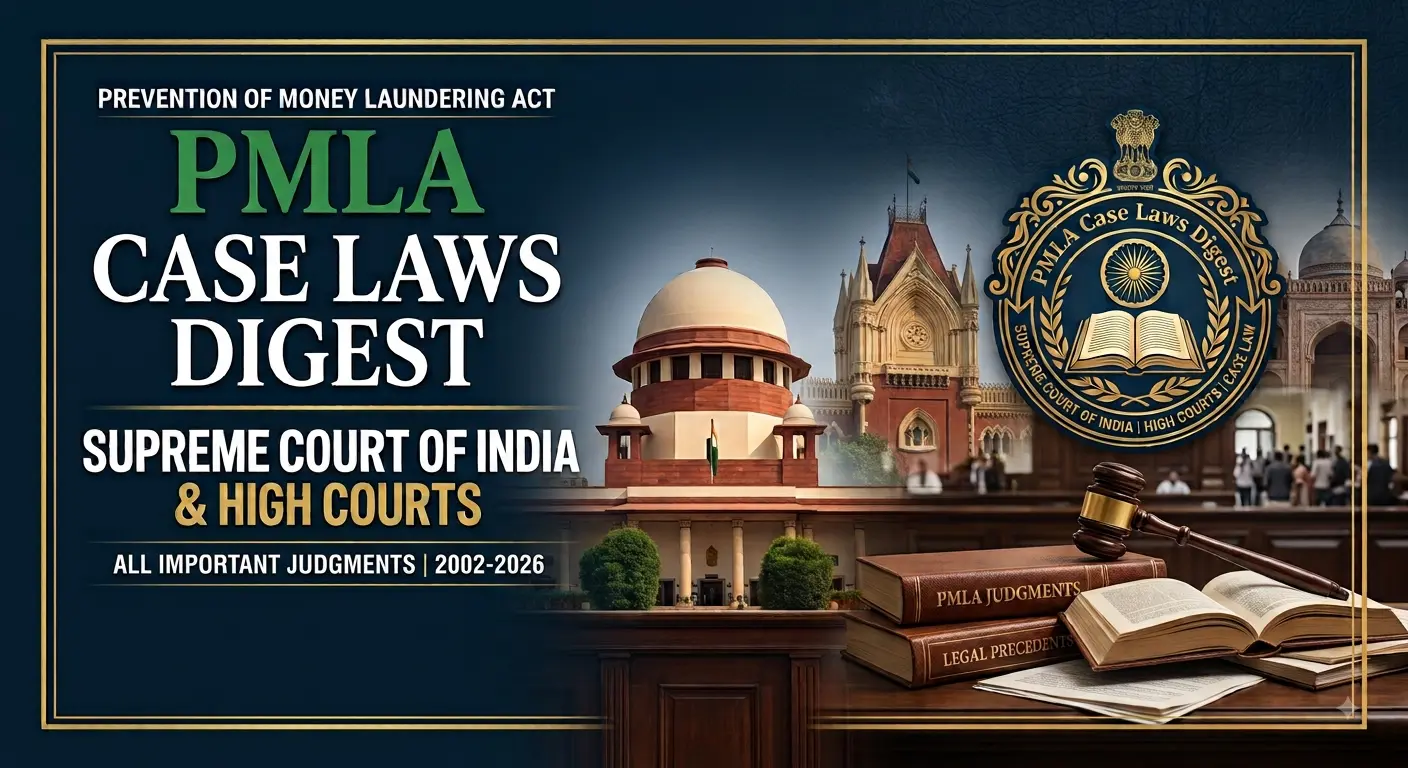
Every PMLA matter turns on precedent. The statute is short; the case law is vast. Over the last few years, the Supreme Court and the High Courts have reshaped almost every aspect of the law — the offence, the ECIR, arrest, attachment, bail, and trial.
This digest brings that case law together in one place. I have organised more than fifty judgments by theme. For each, I give the case name and citation, the facts in brief, the sections involved, and the ratio laid down. Wherever possible, I have linked the full judgment. I have cross-checked each citation and ratio against primary and reputable secondary sources.
Use this as a reference. For a plain-language overview of the law itself, start with my cornerstone guide: Introduction to PMLA and ED Law in India. Each themed section below also links to my detailed article on that stage.
How to use this digest: the cases are grouped by subject — constitutional foundation, the offence and proceeds of crime, ECIR, arrest, search and seizure, attachment, bail, trial and cognizance, and quashing. Jump to the theme you need.
Part I — The Constitutional Foundation
Related reading: Leading Case Laws on ED and PMLA Matters
1. Vijay Madanlal Choudhary v. Union of India, (2022) 10 SCC 24
Facts: A batch of over 240 petitions challenged the constitutional validity of the core provisions of the PMLA — the definition of money laundering, the ED’s powers of arrest, search, attachment, and the recording of statements, and the reverse burden and twin bail conditions. Sections: 3, 5, 8, 17, 18, 19, 24, 45, 50 PMLA. Ratio: The Supreme Court upheld the constitutional validity of these provisions. Section 3 is wide and covers every process or activity connected with proceeds of crime; the word “and” was read as “or”. ED officers are not police officers, so Section 50 statements do not attract Section 25 of the Evidence Act. The ECIR is an internal document, not an FIR, and its supply is not mandatory. The amended Section 45 twin conditions are valid and apply to anticipatory bail. Critically, if the scheduled offence ends in acquittal, discharge, or quashing, there are no proceeds of crime, and the PMLA case cannot survive. Read the judgment.
2. Nikesh Tarachand Shah v. Union of India, (2018) 11 SCC 1
Facts: The petitioner challenged the original twin conditions for bail under Section 45, which required the court to be satisfied of innocence in relation to the scheduled offence. Sections: 45 PMLA; Articles 14, 21. Ratio: The Court struck down the twin conditions as they then stood, holding the classification manifestly arbitrary and violative of Articles 14 and 21. This prompted the 2018 amendment, later upheld in Vijay Madanlal.
3. P. Chidambaram v. Directorate of Enforcement, (2019) 9 SCC 24
Facts: The former Union Finance Minister sought anticipatory bail in the INX Media money-laundering case. Sections: 45 PMLA; 438 CrPC. Ratio: Economic offences involving deep-rooted conspiracies and loss of public funds must be viewed seriously at the bail stage. Even so, later rulings in the same line affirmed that prolonged pre-trial custody cannot indefinitely override liberty.
4. Rohit Tandon v. Directorate of Enforcement, (2018) 11 SCC 46
Facts: A demonetisation-era case involving conversion of large sums of banned currency; bail was sought under the PMLA. Sections: 3, 4, 45 PMLA. Ratio: At the bail stage the court does not conduct a mini-trial. The limited question is whether reasonable grounds exist to believe the accused is not guilty. Confessional statements under Section 50 are admissible and can be considered.
Part II — The Offence, Proceeds of Crime and Scheduled Offences
Related reading: Proceeds of Crime and Scheduled Offences Under the PMLA
5. Pavana Dibbur v. Directorate of Enforcement, 2023 INSC 1029
Facts: The appellant, not named in the predicate FIRs, was prosecuted under the PMLA; apart from Section 120B IPC, no scheduled offence figured in the chargesheets. One property was acquired in 2013, before the alleged crimes. Sections: 2(1)(u), 2(1)(y), 3 PMLA; 120B IPC. Ratio: Section 120B IPC becomes a scheduled offence only if the conspiracy is to commit an offence itself included in the Schedule. A person need not be an accused in the scheduled offence to be prosecuted for money laundering — but there must be a scheduled offence, and property acquired before the crime cannot itself be tainted. The complaint was quashed. Read the judgment.
6. Yash Tuteja v. Union of India, 2024 INSC 301
Facts: The ED’s complaint rested on offences under the Income-tax Act read with Section 120B and other IPC provisions; none except 120B was a scheduled offence. Sections: 2(1)(y), 3, 44(1)(b) PMLA; 120B IPC. Ratio: Applying Pavana Dibbur, since no scheduled offence existed, there could be no proceeds of crime and no offence under Section 3. The Court also held that once a complaint is filed before the Special Court, Sections 200 to 204 CrPC apply to it. The complaint was quashed. Read the judgment.
7. Parvathi Kollur v. State (E.D.), 2022 SCC OnLine SC 1975
Facts: The accused in the predicate corruption case were acquitted; the PMLA prosecution was challenged. Sections: 3, 2(1)(u) PMLA. Ratio: Where the accused is acquitted or discharged in the scheduled offence, there are no proceeds of crime, and the money-laundering prosecution cannot continue. This applied the Vijay Madanlal principle directly.
8. Directorate of Enforcement v. Padmanabhan Kishore, (2022) SCC OnLine SC 1490
Facts: The question was whether a person who handed a bribe could be prosecuted for money laundering. Sections: 3 PMLA; Prevention of Corruption Act. Ratio: Once tainted money is handed over as a bribe, it becomes proceeds of crime, and dealing with it can attract Section 3. The Court clarified the reach of the offence to the giver of illicit money in appropriate facts.
9. Deputy Director, Directorate of Enforcement v. Axis Bank, 2019 SCC OnLine Del 7854
Facts: Banks holding prior mortgages found the mortgaged assets attached by the ED as proceeds of crime. Sections: 2(1)(u), 5, 8 PMLA. Ratio: Attachable property falls into three categories — tainted property, its value, and alternative “deemed tainted” property. A bona fide third party with a prior, lawful interest — such as a secured creditor whose charge predates the offence — is protected; such interests prevail over the attachment. Read the judgment.
10. Seema Garg v. Deputy Director, Directorate of Enforcement, 2020 SCC OnLine P&H 738
Facts: The ED attached properties purchased in 1991 and 2012; the alleged scheduled offence occurred in 2013. Sections: 2(1)(u), 5, 8 PMLA. Ratio: “Value of such property” does not permit attachment of any unconnected asset. Property acquired before the scheduled offence — or before the PMLA — cannot be attached, unless the actual proceeds are held or taken outside India. The properties were released. Read the judgment.
Part III — The ECIR
Related reading: ECIR Explained: ECIR vs FIR, Can You Get a Copy, and Can It Be Quashed?
11. Pawan Insaa v. Directorate of Enforcement, 2024 SCC OnLine P&H (10 April 2024)
Facts: The petitioner stood discharged in the predicate offences; the ED’s ECIR of 2018 continued. Sections: 3, 44 PMLA. Ratio: Following Vijay Madanlal and Parvathi Kollur, once the accused is discharged in the scheduled offence, the ECIR-based proceedings amount to an abuse of process and were quashed. Read the judgment.
12. Directorate of Enforcement v. Akhilesh Singh, 2024 SCC OnLine Del (30 April 2024)
Facts: The accused was acquitted in the predicate offence; the Special Judge discharged him under the PMLA, and the ED appealed. Sections: 3, 44 PMLA. Ratio: The Delhi High Court upheld the discharge, following Emta Coal Ltd. v. Deputy Director (2023 SCC OnLine Del 6177): with the predicate offence gone, no proceeds of crime survive and the PMLA case must end. Read the judgment.
13. Chetan Gupta v. Directorate of Enforcement, 2024 SCC OnLine P&H 1326
Facts: The accused was acquitted in the primary offence; he sought termination of the ED proceedings. Sections: 3, 44 PMLA. Ratio: PMLA proceedings are subservient to the primary proceedings. Since the ECIR is only an internal record, quashing the ECIR by itself serves no purpose; the correct relief is quashing of the proceedings and complaint arising from it.
14. Niket Kansal v. Union of India, 2025 (J&K&L HC, 22 May 2025)
Facts: The accused sought quashing of PMLA proceedings after developments in the predicate case; the ECIR rested on more than one basis. Sections: 3, 44 PMLA. Ratio: Quashing of the predicate offence on purely technical or jurisdictional grounds does not automatically end the PMLA case; where the ECIR spans multiple predicate FIRs or the discharge is under challenge, courts proceed with caution. Read the judgment.
Part IV — Summons and Statements Under Section 50
Related reading: Received an ED Summons Under Section 50 PMLA? Rights, Duties, and How to Respond
15. Abhishek Banerjee v. Directorate of Enforcement, 2024 INSC 668
Facts: Residents of Kolkata challenged Section 50 summonses requiring their appearance in Delhi; they argued the money trail had no Delhi nexus and that women were exempt under Section 160 CrPC. Sections: 50, 65, 71 PMLA; 160 CrPC. Ratio: Section 50 is a self-contained power and overrides the territorial limits and gender exemption of Section 160 CrPC. The ED can summon any person to its designated office; summoning to Delhi was valid because the trail touched Delhi. Read the judgment.
16. Prem Prakash v. Union of India, 2024 INSC 637
Facts: An aide of the Jharkhand Chief Minister, in custody in the same ED matter, challenged reliance on his Section 50 statements and sought bail after long incarceration. Sections: 25 (Evidence Act); 50, 45 PMLA; Article 21. Ratio: A Section 50 statement recorded while the maker is in custody of the same agency is not voluntary and is inadmissible against him. “Bail is the rule, jail is the exception” applies even under the PMLA; prolonged custody without trial progress justifies bail despite Section 45. Read the judgment.
17. Ashish Mittal v. Directorate of Enforcement (Delhi HC)
Facts: A person summoned under Section 50, not named as an accused, sought pre-arrest protection. Sections: 50, 19 PMLA; 438 CrPC. Ratio: The Section 50 summons power is distinct from the Section 19 arrest power. A mere summons does not by itself amount to an apprehension of arrest justifying anticipatory bail, though the remedy remains available on a genuine, demonstrable apprehension.
Part V — Arrest Under Section 19
Related reading: Arrest Under Section 19 PMLA: Grounds of Arrest, Remand, and Remedies
18. V. Senthil Balaji v. State, (2024) 3 SCC 51
Facts: A Tamil Nadu minister challenged his ED arrest and the grant of custody. Sections: 19 PMLA; Article 22. Ratio: Section 19 requires strict compliance, and the grounds of arrest must be conveyed to the arrestee; non-compliance vitiates the arrest. The ED may seek custody of the arrestee within the first fifteen days of remand.
19. Pankaj Bansal v. Union of India, (2024) 3 SCC 358
Facts: The directors of M3M were arrested with the grounds merely read out to them; a second ECIR was registered immediately after they obtained protection in the first. Sections: 19 PMLA; Article 22(1). Ratio: The written grounds of arrest must be furnished to the arrestee as a matter of course. Oral communication is insufficient. The conduct of registering a fresh ECIR to defeat court protection was deprecated as arbitrary. The arrests and remands were set aside. Read the judgment.
20. Ram Kishor Arora v. Directorate of Enforcement, (2024) 3 SCC 322
Facts: The reach in time of the Pankaj Bansal rule on written grounds was in question. Sections: 19 PMLA. Ratio: Pankaj Bansal operates prospectively from 3 October 2023. Written grounds of arrest must be furnished within 24 hours of arrest.
21. Prabir Purkayastha v. State (NCT of Delhi), 2024 INSC 414
Facts: In a UAPA case, the accused was not supplied written grounds of arrest before remand. Sections: 43B UAPA; Article 22(1) (principle applied to PMLA). Ratio: “Reasons for arrest” (generic) differ from “grounds of arrest” (specific and personal); only written grounds satisfy Article 22(1). Absent written grounds, the arrest and remand are a nullity. The safeguard extends beyond the PMLA to all such statutes. Read the judgment.
22. Arvind Kejriwal v. Directorate of Enforcement, 2024 INSC 512
Facts: The Delhi Chief Minister challenged his ED arrest in the excise-policy matter. Sections: 19 PMLA. Ratio: The officer’s “reasons to believe” guilt are judicially reviewable for a rational nexus with the material. The ED cannot arrest merely for the purpose of investigation, and a remand order does not cure an arrest that violates Section 19. The question whether “need and necessity of arrest” is a separate ground was referred to a larger Bench. Read the judgment.
23. Tarsem Lal v. Directorate of Enforcement, 2024 INSC 434
Facts: Accused who had not been arrested during investigation faced complaints after the Special Court took cognizance. Sections: 19, 44, 45 PMLA; 88 CrPC. Ratio: Once the Special Court takes cognizance, the ED cannot arrest the accused under Section 19. An accused appearing on summons is not in custody and need not seek bail; bonds under Section 88 CrPC suffice. Read the judgment.
24. Directorate of Enforcement v. Subhash Sharma, 2025 (Supreme Court)
Facts: The legality of an arrest and the failure to observe production safeguards were in issue. Sections: 19, 65 PMLA; 57 CrPC; Article 22(2). Ratio: Section 57 CrPC, embodying the Article 22(2) mandate on production within 24 hours, applies to PMLA proceedings through Section 65, there being no inconsistency. Violation of the production safeguard renders the detention illegal.
Part VI — Search, Seizure and Freezing (Sections 17 & 18)
Related reading: Search and Seizure Under Sections 17 & 18 PMLA: ED Raids and Your Rights
25. Opto Circuit India Ltd. v. Axis Bank, 2021 SCC OnLine SC 55
Facts: The ED directed banks to freeze the company’s accounts by a communication that recorded no reasons and was not sent to the Adjudicating Authority in a sealed cover. Sections: 17(1A), 17(2) PMLA; 102 CrPC. Ratio: Freezing under Section 17(1A) requires recorded reasons to believe on the file, sealed-cover transmission to the Adjudicating Authority, and compliance with the retention procedure. Where a statute prescribes a manner, it must be followed. The freezing was set aside and defreezing directed. Read the judgment.
26. Directorate of Enforcement v. Gautam Khaitan / State amendments line
Facts: Challenges arose to searches conducted after the 2019 deletion of the proviso to Section 17 that had required a prior report in the scheduled offence. Sections: 17 PMLA. Ratio: Vijay Madanlal upheld the deletion, holding the remaining safeguards — recorded reasons, senior-rank authorisation, and sealed-cover reporting — adequate. A search no longer requires a pre-existing report in the scheduled offence, but must still satisfy those safeguards.
Part VII — Attachment, Adjudication and Appeals (Sections 5, 8, 26, 42)
Related reading: Adjudicating Authority and Appellate Tribunal Under the PMLA and Third-Party Challenges to ED Attachment
27. Kaushal Kishore / J. Sekar (Sekar Reddy) v. Union of India, 2018 SCC OnLine Del 6523
Facts: The scope of provisional attachment and the safeguards of adjudication were tested. Sections: 5, 8 PMLA. Ratio: Provisional attachment is a serious civil consequence and must strictly follow the statutory scheme; the Adjudicating Authority must independently apply its mind before confirmation, and recorded reasons are essential.
28. Vijay Madanlal Choudhary (on Section 8(4) possession)
Facts: The validity of taking possession of attached property upon confirmation was challenged. Sections: 5, 8(4) PMLA. Ratio: The power to take possession under Section 8(4) survives, but should be exercised only in exceptional circumstances — particularly regarding a residence — and not as a matter of routine. Confirmation restrains dealings; it does not transfer title.
29. Kanishka Matta / cash-seizure line (M.P. HC)
Facts: The question was whether the ED can seize cash not specifically described in the search authorisation. Sections: 17 PMLA. Ratio: The expression “any other property” in Section 17 is wide enough to include cash discovered during a lawful search connected to proceeds of crime; such seizure, followed by the retention procedure, is valid.
30. Nik Nish Retail Ltd. / Appellate Tribunal secured-creditor line
Facts: Banks with prior charges appealed against confirmation of attachment of mortgaged assets. Sections: 5, 8, 26 PMLA; SARFAESI Act. Ratio: Applying Axis Bank, a secured creditor with a bona fide, prior charge is entitled to enforce its security; the attachment operates subject to that prior legitimate interest.
Part VIII — Bail Under Section 45
Related reading: Bail in PMLA Cases: Supreme Court and Delhi High Court — Complete Guide and Bail in White-Collar Crimes: Latest Supreme Court Judgments
31. Directorate of Enforcement v. M. Gopal Reddy, 2022 SCC OnLine SC 1862
Facts: A High Court had granted anticipatory bail without applying the Section 45 conditions. Sections: 45 PMLA; 438 CrPC. Ratio: The twin conditions of Section 45 apply to anticipatory bail as well; a smaller Bench cannot bypass the three-Judge ruling in Vijay Madanlal.
32. Manish Sisodia v. Directorate of Enforcement, 2024 INSC 595 (Sisodia II)
Facts: The former Delhi Deputy Chief Minister had spent about 17 months in custody in the excise-policy matter, with the trial yet to begin. Sections: 45 PMLA; Article 21. Ratio: The right to a speedy trial is a facet of Article 21. Where trial delay is not attributable to the accused, Section 45 cannot justify indefinite detention, and constitutional courts can grant bail. “Bail is the rule, jail is the exception” applies to the PMLA.
33. V. Senthil Balaji v. Deputy Director, ED, 2024 INSC 739
Facts: The accused had been in custody over a year with no realistic prospect of the trial concluding soon. Sections: 45 PMLA; Article 21. Ratio: Stringent bail conditions cannot coexist with indefinite pre-trial incarceration; where the trial will not conclude within a reasonable time, the constitutional court must grant bail. Special statutes cannot become instruments of pre-conviction punishment.
34. Kalvakuntla Kavitha v. Directorate of Enforcement, 2024 INSC 632
Facts: A woman accused and sitting legislator in the excise-policy matter was denied the benefit of the first proviso to Section 45(1) by the High Court. Sections: 45(1) proviso PMLA. Ratio: The proviso relaxing the twin conditions for women cannot be denied by labelling the accused “highly educated” or “well-placed”. A woman accused is entitled to the benefit of the proviso on its terms.
35. Saumya Chaurasia v. Directorate of Enforcement, 2023 INSC 1073
Facts: A woman accused sought the benefit of the first proviso to Section 45(1); the ED argued she was sophisticated and highly placed. Sections: 45(1) proviso PMLA. Ratio: The proviso is not confined to a “vulnerable” woman. Courts must adopt a sensitive approach; a woman is not deprived of the proviso’s benefit merely because she is educated or holds public office. However, the proviso’s application remains discretionary on the facts.
36. Prem Prakash v. Union of India, 2024 INSC 637 (on Section 24)
Facts: The interplay of the twin conditions and the Section 24 presumption arose at the bail stage. Sections: 24, 45 PMLA. Ratio: The Section 24 presumption operates only after the prosecution makes out a cogent case on the twin tests; the burden then shifts to the accused. The presumption does not relieve the ED of establishing the foundational facts.
37. Union of India v. Kanhaiya Prasad, 2025 INSC 210
Facts: A High Court granted PMLA bail through a brief order without recording satisfaction on the twin conditions. Sections: 45 PMLA. Ratio: The twin conditions are mandatory. The delay-based relaxations in Sisodia, Prem Prakash, and Senthil Balaji contextualise Section 45 but do not displace it. Cryptic bail orders ignoring the statutory mandate are liable to be set aside.
38. Ramkripal Meena v. Directorate of Enforcement, 2024 (SLP Crl.)
Facts: A PMLA accused sought bail on the ground of long incarceration with a distant trial. Sections: 45 PMLA; Article 21. Ratio: The rigours of Section 45 can be suitably relaxed to afford conditional liberty where the accused has been in custody for a long period and the trial is unlikely to conclude soon. This reasoning was later relied on in Sisodia II and Prem Prakash.
39. Udhaw Singh v. Directorate of Enforcement, 2025 (Supreme Court)
Facts: The accused had been in custody for about 14 months with numerous witnesses and no early end to trial in sight. Sections: 45 PMLA; Article 21. Ratio: Relying on V. Senthil Balaji, bail was granted; prolonged incarceration with a protracted trial ahead justifies relaxation of Section 45.
40. Mahesh Joshi v. Directorate of Enforcement, 2025 (Supreme Court)
Facts: A 71-year-old accused was granted bail after about seven months of pre-trial detention, with no clear trial timeline. Sections: 45 PMLA; Article 21. Ratio: Where trial delays are attributable to the State, Article 21 overrides the stringency of Section 45. The process itself cannot become the punishment; age and health are relevant considerations.
41. Hemant Soren v. Directorate of Enforcement, 2024 (bail line)
Facts: The Jharkhand Chief Minister challenged his arrest and sought bail in a land-related ECIR; his name did not appear in key recovered records. Sections: 19, 45 PMLA. Ratio: The Supreme Court declined to interfere with the High Court’s reasoned bail order; where prima facie material directly linking the accused to possession of proceeds is absent, and the twin conditions are met, bail is justified.
42. Vijay Nair v. Directorate of Enforcement, 2025 (Supreme Court)
Facts: An accused in the excise-policy matter sought bail after long custody with the material largely comprising co-accused statements. Sections: 45, 50 PMLA; Article 21. Ratio: Following the Sisodia–Prem Prakash line, prolonged incarceration without imminent trial conclusion justified bail; the veracity of Section 50 statements of co-accused is a matter for trial.
Part IX — Trial, Cognizance and Disclosure
Related reading: Trial Before the PMLA Special Court: Prosecution Complaint, Section 24 Burden, Sanction and Disclosure
43. Directorate of Enforcement v. Bibhu Prasad Acharya, 2024 INSC 843
Facts: The Special Court took cognizance of PMLA complaints against two IAS officers for acts connected with official duty, without prior sanction; the High Court quashed cognizance. Sections: 44(1)(b), 65, 71 PMLA; 197(1) CrPC. Ratio: Section 197(1) CrPC applies to PMLA complaints. Prior sanction is necessary before cognizance against a public servant for acts done in discharge of official duty; there is no inconsistency with the PMLA. The ED may seek cognizance afresh once sanction is obtained. Read the judgment.
44. Sarla Gupta v. Directorate of Enforcement, 2025 INSC 645
Facts: The ED seized voluminous documents but supplied the accused only the selected, relied-upon material; applications for the rest were refused by the Special Court and the High Court. Sections: 17, 18, 24, 44 PMLA; 91, 207 CrPC. Ratio: The accused is entitled to true copies of documents seized from him regardless of reliance; a list of all unrelied documents must be furnished at cognizance; and production of specific unrelied documents may be sought at charge and even at the Section 45 bail stage. Given the Section 24 burden, the right to seek documents must be liberally construed. Read the judgment.
45. Kushal Kumar Agarwal v. Directorate of Enforcement, 2025 SCC OnLine SC 1221
Facts: The Special Court took cognizance of an ED complaint filed after 1 July 2024 without giving the accused a pre-cognizance hearing. Sections: 44(1)(b) PMLA; 223(1) BNSS. Ratio: The first proviso to Section 223(1) BNSS — mandating a hearing before cognizance — is substantive and mandatory and applies to PMLA complaints. Cognizance taken without hearing the accused is vitiated.
46. Parvinder Singh v. Directorate of Enforcement, 2026 (Supreme Court)
Facts: Cognizance was taken on an ED complaint without a pre-cognizance hearing; the ED urged reconsideration of Kushal Kumar Agarwal. Sections: 44(1)(b) PMLA; 223(1) BNSS. Ratio: Reaffirming Tarsem Lal, Yash Tuteja, and Kushal Kumar Agarwal, the Court held Sections 223–228 BNSS apply to PMLA proceedings; cognizance without a hearing is void ab initio. The cognizance order was set aside and the matter remitted; an accused who objects promptly cannot be blamed for the delay.
47. Tarsem Lal / Yash Tuteja (on complaint procedure)
Facts: The applicability of the CrPC complaint procedure to PMLA prosecution complaints was in issue. Sections: 44, 46 PMLA; 200–204 CrPC / 223–228 BNSS. Ratio: A complaint under Section 44(1)(b) PMLA is governed by the CrPC provisions on complaints (now the corresponding BNSS provisions), there being no inconsistency; excluding them would produce disastrous consequences for the accused’s procedural rights.
Part X — Quashing and Abuse of Process
Related reading: Quashing of Criminal Proceedings by the Delhi High Court and Quashing under Section 482 CrPC / 528 BNSS
48. State of Haryana v. Bhajan Lal, 1992 Supp (1) SCC 335
Facts: The foundational case on the inherent power to quash criminal proceedings. Sections: 482 CrPC (now 528 BNSS); applied to PMLA via Article 226. Ratio: The seven illustrative categories for quashing — no prima facie offence, absurd allegations, mala fide prosecution, and others — apply to PMLA proceedings, allowing High Courts to terminate manifestly untenable ECIRs and complaints.
49. Anand Kumar Mohatta v. State (NCT of Delhi), (2019) 18 SCC 213
Facts: Quashing was sought after the chargesheet had been filed. Sections: 482 CrPC. Ratio: The power to quash survives the filing of a chargesheet/complaint. The court examines the material; if no offence is made out even then, proceedings must be quashed — a principle applied to PMLA prosecution complaints.
50. Directorate of Enforcement v. Kapil Wadhawan / Radhika Agarwal (arrest-safeguards extension), 2025
Facts: The reach of PMLA-style arrest safeguards to allied economic statutes was considered. Sections: 19 PMLA (principle); Customs Act; CGST Act. Ratio: The written-grounds-of-arrest and “reasons to believe” safeguards developed in the PMLA line (Pankaj Bansal, Prabir Purkayastha) inform arrests under Customs and GST law; arrest powers under economic statutes carry comparable due-process obligations.
51. Vijay Madanlal Choudhary — continuing offence clarification
Facts: The temporal scope of Section 3 was in question — whether laundering is a one-time or continuing offence. Sections: 3 PMLA. Ratio: Money laundering is a continuing offence; it continues so long as the proceeds of crime are held, used, concealed, or projected as untainted. The timing of a single past act does not extinguish liability.
How the Cases Fit Together
Read as a whole, the digest reveals a clear pattern. Vijay Madanlal Choudhary upholds the ED’s powers, but the later cases fill those powers with safeguards. The offence needs a genuine scheduled offence (Pavana Dibbur, Yash Tuteja) and real proceeds of crime (Seema Garg, Parvathi Kollur). Arrest demands written grounds and reviewable reasons (Pankaj Bansal, Prabir Purkayastha, Arvind Kejriwal), and stops at cognizance (Tarsem Lal). Search and freezing must follow procedure (Opto Circuit). Attachment protects bona fide interests (Axis Bank). Bail, though hard, yields to delay (Sisodia, Senthil Balaji, Prem Prakash) while never becoming casual (Kanhaiya Prasad). And the trial now guarantees a pre-cognizance hearing (Kushal Kumar Agarwal, Parvinder Singh) and fair disclosure (Sarla Gupta).
For the accused and for third parties alike, this body of law offers real, structured protection — provided it is invoked precisely, at the right stage.
Frequently Asked Questions (FAQ)
Q1. Which is the most important PMLA judgment? Vijay Madanlal Choudhary v. Union of India (2022) is the foundational ruling. It upheld the ED’s core powers while recognising the safeguards that later judgments have enforced.
Q2. Can a PMLA case survive if the scheduled offence is quashed? No. Parvathi Kollur and Vijay Madanlal hold that acquittal, discharge, or quashing of the scheduled offence ends the PMLA case, as there are then no proceeds of crime.
Q3. What did Pankaj Bansal decide about arrest? That the ED must furnish the written grounds of arrest to the arrestee as a matter of course; oral communication is not enough. Ram Kishor Arora clarified this applies prospectively, within 24 hours.
Q4. Has the Supreme Court made PMLA bail easier? It has held that Section 45’s twin conditions cannot justify indefinite detention where trials are delayed (Sisodia, Senthil Balaji, Prem Prakash), while insisting the conditions still be applied properly (Kanhaiya Prasad).
Q5. Must the Special Court hear the accused before taking cognizance? Yes, for complaints heard after 1 July 2024. Kushal Kumar Agarwal and Parvinder Singh hold the pre-cognizance hearing under Section 223(1) BNSS mandatory; its absence renders cognizance void ab initio.
Q6. Is this digest a substitute for legal advice? No. It is a reference to the leading case law. Every matter turns on its own facts, and the law continues to evolve; consult a qualified advocate for your specific situation.
Conclusion
The PMLA is governed less by its sections than by the case law interpreting them. This digest gathers that case law in one place, with facts, sections, and ratio for each judgment, cross-checked against the sources. I will update it as new decisions arrive — the pending reviews of Vijay Madanlal and the larger-Bench reference on arrest may yet redraw parts of the map.
Further explore the full PMLA section of this blog
- Fugitive Economic Offenders Act, 2018: Meaning, Process, Confiscation, and Case Laws

- FEMA vs PMLA: The Key Differences Between the ED’s Two Laws

- PMLA Guide: The Complete Guide to Money Laundering Law, ED Powers, and Your Rights in India

- PMLA Compliance for Reporting Entities: KYC, Record-Keeping, and STRs Under Section 12

- PMLA and IBC: How Section 32A Protects a Corporate Debtor’s Assets from ED Attachment
- Can the ED Take Your House? PMLA Attachment, Possession, and Confiscation Explained

- What to Do If the ED Contacts You: A Step-by-Step Survival Guide

- Scheduled Offences Under PMLA

- Anticipatory Bail in PMLA Cases: Law, the Section 45 Twin Conditions, and How to Get It
- PMLA Case Laws Digest: 50+ Landmark Supreme Court and High Court Judgments on Money Laundering

- Trial Before the PMLA Special Court: Prosecution Complaint, the Section 24 Reverse Burden, Sanction, and Disclosure

- Adjudicating Authority and Appellate Tribunal Under the PMLA: Show-Cause Notices, Section 8 Adjudication, and Appeals Under Sections 26 & 42

- Search and Seizure Under Sections 17 & 18 PMLA: ED Raids and Your Rights — A Practitioner’s Guide

- Proceeds of Crime and Scheduled Offences Under the PMLA: Definition, the Schedule, and the Nexus Requirement

- Arrest Under Section 19 PMLA: Grounds of Arrest, Remand, and Remedies — What to Do in the First 24 Hours

- ECIR Explained: ECIR vs FIR, Can You Get a Copy, and Can It Be Quashed? A Practitioner’s Guide

- Received an ED Summons Under Section 50 PMLA? Rights, Duties, and How to Respond – A Practitioner’s Guide

- How Third Parties With Legitimate Interests Can Contest Attachment Under the PMLA by the ED

- Introduction to Money Laundering, PMLA and ED Law in India: A Complete Guide

- Quashing of Criminal Proceedings by the Delhi High Court: Law, Tests, Landmark Case Laws and Procedure

- Leading Case Laws on ED and PMLA Matters: Landmark Supreme Court Judgments Every Practitioner Must Know

- Bail in PMLA Cases: Supreme Court and Delhi High Court — Complete Guide (2026)