Introduction
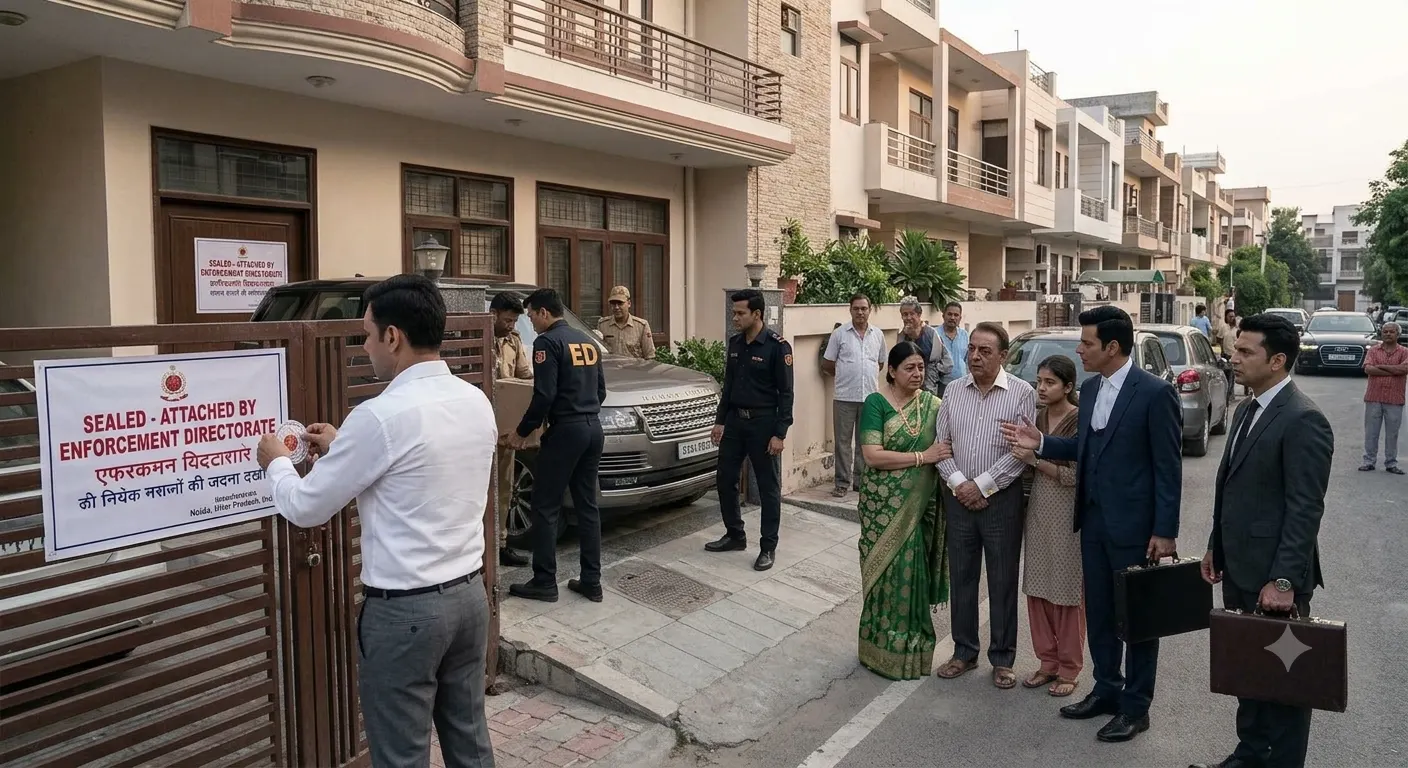
In my years of handling PMLA matters, one situation troubles clients the most. The ED attaches a property. Yet the owner is not the accused. He is a buyer, a bank, a landlord, or a family member. He asks me one question: “I have done nothing wrong. Can I get my property released?” The answer is yes – if you act correctly, at the right forum, with the right material. This article explains how.
Why the ED Can Attach a Third Party’s Property at All
First, understand the ED’s power. Section 5 of the PMLA allows the Director to provisionally attach property believed to be “proceeds of crime.” Significantly, the section speaks of property of “any person.” It does not say “any accused.”
Furthermore, the definition of “proceeds of crime” under Section 2(1)(u) includes the “value of such property.” Therefore, when the actual tainted asset is untraceable, the ED attaches equivalent untainted assets. Frequently, those assets belong to third parties.
The Supreme Court upheld this architecture in Vijay Madanlal Choudhary v. Union of India, (2022) 10 SCC 24. However, the Court emphasised the in-built safeguards. Those safeguards are precisely what a third party must invoke. For the broader framework of the Act, read my cornerstone guide: Introduction to PMLA and ED Law in India.
The Statutory Safeguards for Third Parties
The Act itself protects legitimate interests. In practice, I rely on five provisions:
- Section 5(1) — recorded reasons. The officer must record written “reasons to believe.” Vague reasons vitiate the attachment.
- Section 5(1), first proviso — the 365-day cap. Where no chargesheet exists in the scheduled offence, attachment during pending investigation has time limits.
- Section 5(3) — the 180-day life. A provisional attachment lapses unless the Adjudicating Authority confirms it within 180 days.
- Section 8(1) and 8(2) — the right to be heard. The Adjudicating Authority must issue notice to every person holding the property. It must consider his claim before confirmation.
- Section 8(8), proviso — restoration. Even during trial, the Special Court may restore property to a “claimant with a legitimate interest” who acted in good faith.
Additionally, the Restoration of Confiscated Property Rules, 2016 (as amended in 2019) operationalise restoration. Consequently, the law does not treat third parties as collateral damage. It gives them standing at every stage.
The Leading Case: Deputy Director, ED v. Axis Bank (Delhi High Court, 2019)
Every third-party challenge begins with this judgment. In Deputy Director, Directorate of Enforcement v. Axis Bank, 2019 SCC OnLine Del 7854, decided on 2 April 2019, banks had lent money against mortgaged assets. Later, the ED attached those very assets as “deemed tainted property.”
The Court has laid down the governing tests. A third-party claimant must show four things. He has a legitimate interest in the property. Acted in good faith. Took all reasonable precautions. Finally, he was not involved in the money laundering.
The Court then drew a crucial timeline. If the third party acquired its interest before the commission of the offence, its claim ordinarily prevails. The attachment survives only subject to that prior interest. Accordingly, a secured creditor with a prior mortgage can still enforce its security. Conversely, an interest created after the offence demands proof of genuine due diligence and fair market value.
Principle: Bona fide, prior, and lawful interests trump attachment. In my experience, this single paragraph — paragraph 171 of the judgment — wins more tribunal appeals than any other authority.
Seema Garg: Property Acquired Before the Crime
The second pillar comes from the Punjab and Haryana High Court. In Seema Garg v. Deputy Director, Directorate of Enforcement, 2020 SCC OnLine P&H 738, decided on 6 March 2020, the ED had attached properties purchased in 1991 and 2012. However, the alleged scheduled offence occurred in 2013.
The Division Bench released the properties. It held that property acquired prior to the commission of the scheduled offence — or prior to the PMLA itself — cannot be attached as “value equivalent” property. The only exception applies where the actual proceeds are held or taken outside India. Moreover, the Court insisted on specific recorded reasons. Merely reproducing the words of Section 5 does not suffice.
Principle: The date of acquisition matters decisively. Property that predates the crime is presumptively safe. I always build a precise acquisition timeline in every attachment matter for this reason.
HDFC Bank (Patna High Court, 2021): A Writ That Worked
Third parties sometimes need faster relief. In HDFC Bank Ltd. v. Government of India, decided on 28 June 2021, the Patna High Court entertained a writ petition. The mortgaged properties had no link with any tainted money. Indeed, the borrower had acquired them before any laundering allegation arose.
The Court followed Seema Garg. It held the attachment arbitrary and violative of Section 5. Consequently, it quashed the attachment at the writ stage itself.
Principle: Where the lack of nexus is apparent on the face of the record, Article 226 offers a direct remedy. Nevertheless, courts reserve this route for clear cases. In routine matters, they relegate parties to the statutory ladder.
Other Circumstances Where Third Parties Succeed
From my practice, the following fact patterns regularly secure release:
- The secured creditor with a prior charge. Banks with pre-offence mortgages succeed by applying the Axis Bank tests. The Appellate Tribunal has allowed appeals by leading banks on this exact reasoning.
- The bona fide purchaser. A buyer who paid fair market value through banking channels, conducted a title search, and had no notice of the crime stands on strong ground.
- The lapsed attachment. If the Adjudicating Authority fails to confirm within 180 days, the attachment dies. Similarly, time caps under the first proviso to Section 5(1) can be fatal to the ED’s case.
- The IBC-protected asset. Once a resolution plan stands approved, Section 32A of the Insolvency and Bankruptcy Code bars attachment for prior offences of the corporate debtor. The Supreme Court upheld this provision in Manish Kumar v. Union of India (2021).
- The collapsed predicate case. If the scheduled offence ends in discharge, acquittal, or quashing, the entire PMLA action — attachment included — collapses. My guide on quashing of criminal proceedings under Section 482 CrPC / Section 528 BNSS explains this strategy.
Where to File: The Four Forums
Choose your forum carefully. The ladder runs as follows:
Forum 1 — The Adjudicating Authority, New Delhi. After provisional attachment, the ED files a complaint for confirming such attachement. The Authority then issues a Section 8(1) show-cause notice. You file your reply and claim here first. The Authority sits at New Delhi and hears claimants nationwide.
Forum 2 — The Appellate Tribunal (SAFEMA/PMLA), New Delhi. An order confirming attachment is appealable under Section 26. File within 45 days. The Tribunal can condone delay for sufficient cause.
Forum 3 — The High Court. The Tribunal’s order is appealable under Section 42 on questions of law and fact. File within 60 days. Importantly, the appeal lies to the High Court where the aggrieved party resides or carries on business. This gives third parties a convenient forum.
Forum 4 — Writ jurisdiction. In exceptional cases — no nexus, jurisdictional error, or lapse of time limits — approach the High Court under Article 226 directly, as HDFC Bank did. For Supreme Court remedies, an Advocate-on-Record must file the petition.
Meanwhile, remember Section 8(8). At the trial stage, the Special Court itself can restore property to a legitimate claimant.
How to Draft the Reply or Claim: Contents That Matter
Over the years, I have refined a standard checklist. A strong third-party claim contains:
- The acquisition story. State when, how, and from whom you acquired the property. Attach the sale deed, allotment letter, or mortgage deed.
- The money trail. Prove your consideration through bank statements, loan sanction letters, and income-tax returns. Clean money defeats “proceeds of crime.”
- The timeline chart. Place your acquisition date against the date of the scheduled offence and the ECIR. Seema Garg turns on this comparison.
- The due-diligence record. Annex title-search reports, encumbrance certificates, revenue records, and, for lenders, CERSAI registration.
- The non-involvement plea. Assert, on oath, that you are not an accused and had no knowledge of the offence. Support it with the chargesheet itself, which typically omits your name.
- The legal grounds. Plead the Axis Bank tests, the Seema Garg ratio, defective reasons under Section 5(1), and any lapse of statutory timelines.
- The precise prayer. Seek release of the property, or in the alternative, protection of your interest in any confiscation.
Above all, file within time. I have seen strong claims fail purely on limitation.
Practical Tips From the Trenches
Three final lessons. First, do not ignore the Section 8(1) notice. Silence before the Adjudicating Authority haunts you in appeal. Secondly, keep paying your municipal taxes and maintaining records; conduct consistent with ownership strengthens good faith. Thirdly, coordinate the attachment defence with the main case. Attachment, arrest, and bail interlock. My guides on bail in PMLA cases and the leading case laws on ED and PMLA matters cover those fronts.
What Happens at the Adjudicating Authority Hearing?
Clients often ask me what the hearing actually looks like. The process is civil in character. The Authority reads the ED’s original complaint and your reply. It then hears both sides on documents; it rarely records oral evidence. Therefore, your paper-book wins or loses the case.
Two points deserve emphasis. First, the Authority decides only whether the property is prima facie involved in money laundering. It does not decide guilt. Secondly, confirmation of attachment does not transfer ownership. You lose the right to deal with the property; however, possession of a residence is generally not disturbed until confiscation. Section 8(4) permits the ED to take possession after confirmation, but Vijay Madanlal itself cautioned that this power should be exercised in exceptional circumstances, not as a matter of course. Consequently, even after an adverse order, an appeal with a stay application can preserve the status quo.
Frequently Asked Questions (FAQ)
Q1. Can the ED attach property of a person who is not an accused?
Yes. Section 5 permits attachment of property of “any person.” However, the law equally protects bona fide third parties at adjudication, appeal, and trial.
Q2. What is the time limit to challenge a confirmed attachment?
Appeal to the Appellate Tribunal within 45 days under Section 26. Thereafter, appeal to the High Court within 60 days under Section 42.
Q3. Can a bank enforce its mortgage despite ED attachment?
Generally, yes — if the mortgage predates the offence. Axis Bank case protects the secured creditor’s prior charge, subject to the tests of good faith.
Q4. Does property bought before the crime remain safe?
Ordinarily, yes. Seema Garg holds that pre-offence property cannot be attached unless the actual proceeds are held outside India.
Q5. What happens to the attachment if the main criminal case fails?
It collapses. Without a scheduled offence, there are no proceeds of crime, and the attachment cannot survive.
Conclusion
The PMLA gives the ED a long arm. Nevertheless, it does not give the ED the property of innocent people. The statute, the Axis Bank tests, and the Seema Garg timeline together arm every legitimate third party with a real remedy. Act promptly. Document thoroughly. Choose the right forum. In my experience, courts and tribunals do release property when the claimant proves clean title, clean money, and clean hands.
If the ED has attached your property in someone else’s case, get in touch for a considered strategy, or explore more commentary in my PMLA section.
Read more on PMLA
- Fugitive Economic Offenders Act, 2018: Meaning, Process, Confiscation, and Case Laws

- FEMA vs PMLA: The Key Differences Between the ED’s Two Laws

- PMLA Guide: The Complete Guide to Money Laundering Law, ED Powers, and Your Rights in India

- PMLA Compliance for Reporting Entities: KYC, Record-Keeping, and STRs Under Section 12

- PMLA and IBC: How Section 32A Protects a Corporate Debtor’s Assets from ED Attachment

- Can the ED Take Your House? PMLA Attachment, Possession, and Confiscation Explained

- What to Do If the ED Contacts You: A Step-by-Step Survival Guide

- Scheduled Offences Under PMLA

- Anticipatory Bail in PMLA Cases: Law, the Section 45 Twin Conditions, and How to Get It

- PMLA Case Laws Digest: 50+ Landmark Supreme Court and High Court Judgments on Money Laundering

- Trial Before the PMLA Special Court: Prosecution Complaint, the Section 24 Reverse Burden, Sanction, and Disclosure

- Adjudicating Authority and Appellate Tribunal Under the PMLA: Show-Cause Notices, Section 8 Adjudication, and Appeals Under Sections 26 & 42

- Search and Seizure Under Sections 17 & 18 PMLA: ED Raids and Your Rights — A Practitioner’s Guide

- Proceeds of Crime and Scheduled Offences Under the PMLA: Definition, the Schedule, and the Nexus Requirement

- Arrest Under Section 19 PMLA: Grounds of Arrest, Remand, and Remedies — What to Do in the First 24 Hours

- ECIR Explained: ECIR vs FIR, Can You Get a Copy, and Can It Be Quashed? A Practitioner’s Guide

- Received an ED Summons Under Section 50 PMLA? Rights, Duties, and How to Respond – A Practitioner’s Guide

- How Third Parties With Legitimate Interests Can Contest Attachment Under the PMLA by the ED

- Introduction to Money Laundering, PMLA and ED Law in India: A Complete Guide

- Quashing of Criminal Proceedings by the Delhi High Court: Law, Tests, Landmark Case Laws and Procedure

- Leading Case Laws on ED and PMLA Matters: Landmark Supreme Court Judgments Every Practitioner Must Know

- Bail in PMLA Cases: Supreme Court and Delhi High Court — Complete Guide (2026)