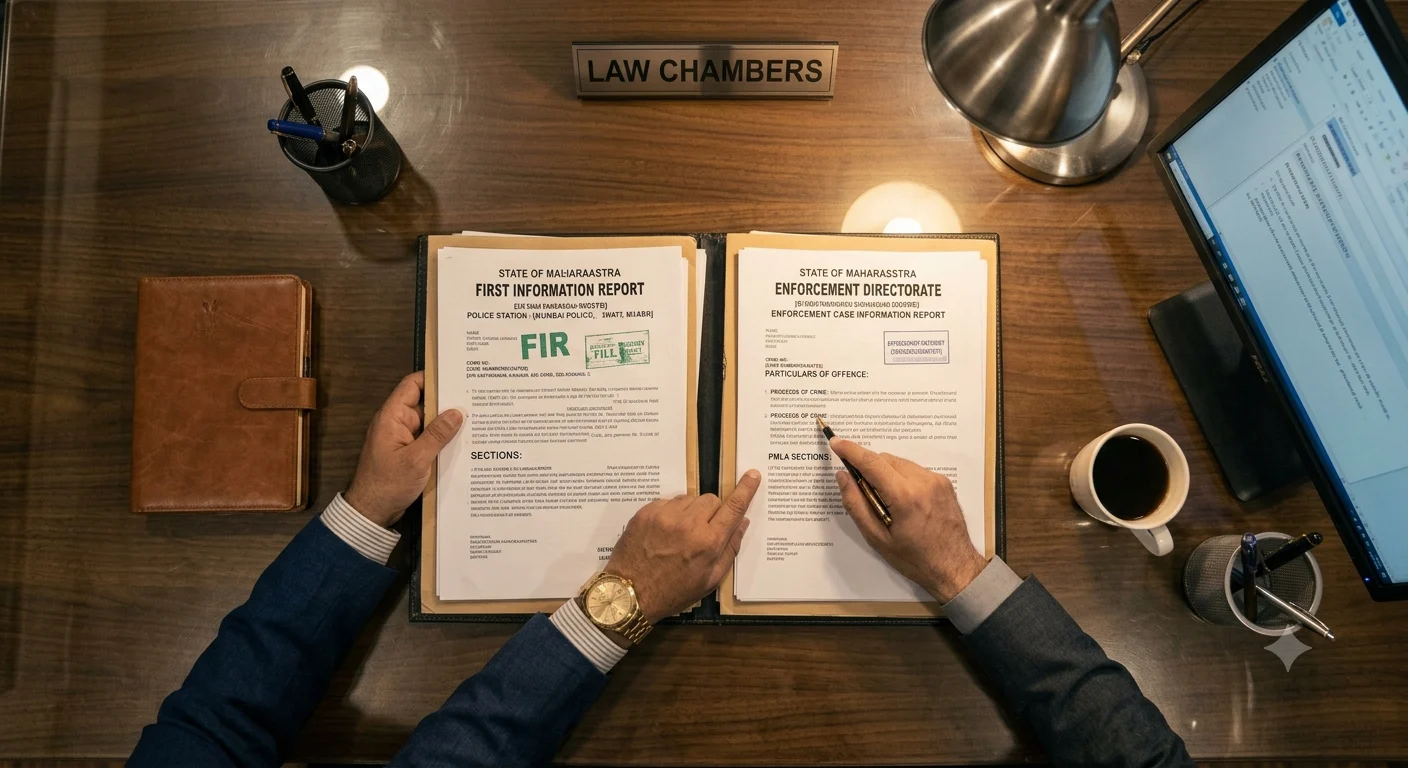
Every ED case begins with four letters: ECIR. Clients bring me summonses that quote an ECIR number and ask the same three questions. What is this document? Can I see it? Can I kill it?
The answers surprise most people. Therefore, I have written this guide to settle each question with settled position of law. Every judgment cited carries a link to its full text. For the overall scheme of the Act, start with my cornerstone guide: Introduction to PMLA and ED Law in India.
What Is an ECIR?
ECIR stands for Enforcement Case Information Report. It is the ED’s case-opening document under the Prevention of Money Laundering Act, 2002. When the ED learns of a scheduled offence generating proceeds of crime — usually from an FIR or chargesheet filed by another agency — it records an ECIR and assigns it a number, such as ECIR/05/DLZO/2024.
Here lies the first surprise. The PMLA nowhere mentions the ECIR. No section creates it. No rule prescribes its form. It is purely an internal, administrative document of the department. The Supreme Court said exactly this in Vijay Madanlal Choudhary v. Union of India, (2022) 10 SCC 24.
Nevertheless, the ECIR matters enormously in practice. Summonses quote it. Searches proceed under it. Attachments and arrests trace back to it. In short, it is the spine of the ED’s file — even though the law does not recognise it as a statutory creature.
ECIR vs FIR: The Crucial Differences
People loosely call the ECIR “the ED’s FIR.” The comparison fails on every legal test. Consider the differences:
First, statutory basis. An FIR flows from Section 154 CrPC (now Section 173 BNSS). The ECIR flows from departmental practice alone.
Second, disclosure. An accused gets a copy of the FIR as a matter of right. In contrast, Vijay Madanlal holds that supply of the ECIR is not mandatory. Disclosure of the grounds at the time of arrest suffices.
Third, judicial oversight at inception. An FIR reaches the Magistrate immediately. The ECIR reaches no court until the ED files its prosecution complaint or seeks remand.
Fourth, trigger. An FIR can be registered on any information of a cognizable offence. An ECIR, however, presupposes a scheduled offence already on record. Without a predicate crime, the ED has no jurisdiction to begin.
Fifth, consequence of quashing. Quashing an FIR ends that case. Quashing the ECIR, as we shall see, is a more slippery prayer — and often the wrong one.
Can You Get a Copy of the ECIR?
The blunt answer: you have no absolute right to it. Vijay Madanlal rejected the demand for mandatory supply. The Court reasoned that the ECIR is an internal document, and premature disclosure could alert launderers.
However, the position is not hopeless. In practice, a PMLA law practicioner extract the substance of the ECIR through four lawful routes:
- The grounds of arrest. If the ED arrests, it must furnish written grounds under Section 19, per Pankaj Bansal. Those grounds necessarily reveal the case.
- The remand stage. The court considering remand must examine the record. Your counsel can test the material there.
- The prosecution complaint. Once the ED files its complaint before the Special Court, you receive the relied-upon documents. Additionally, after Sarla Gupta v. ED (2025), you are entitled to a list of unrelied documents too.
- Court-directed disclosure. In quashing or bail proceedings, courts frequently call for the ECIR and permit inspection where fairness demands it.
Consequently, the denial of a copy delays your knowledge; it does not defeat your defence. Meanwhile, respond to every summons with discipline — my detailed protocol is here: Received an ED Summons Under Section 50 PMLA? Rights, Duties, and How to Respond.
What Follows an ECIR?
An ECIR sets a predictable machinery in motion. The ED issues Section 50 summonses to record statements. It may conduct searches under Sections 17 and 18. It may provisionally attach property under Section 5 — and if your assets get caught in someone else’s case, remember that third parties with legitimate interests can contest attachment. Finally, it may arrest under Section 19, subject to the strict safeguards I have mapped in my guide to the leading case laws on ED and PMLA matters.
Can an ECIR Be Quashed? The Foundation Rule
Now the decisive question. The answer rests on one structural truth: the PMLA case lives and dies with the predicate offence.
Vijay Madanlal laid the rule. If the accused is discharged, acquitted, or the scheduled offence is quashed, the money-laundering case cannot survive. There remain no proceeds of crime. The Supreme Court applied this in Parvathi Kollur v. State (E.D.), 2022 SCC OnLine SC 1975, where acquittal in a corruption case ended the PMLA prosecution.
High Courts now apply the rule routinely:
- Pawan Insaa v. Directorate of Enforcement (Punjab & Haryana High Court, 10 April 2024). The petitioner stood discharged of the predicate offences. The Court quashed the 2018 ECIR as an abuse of process, relying squarely on Vijay Madanlal and Parvathi Kollur.
- Directorate of Enforcement v. Akhilesh Singh (Delhi High Court, 30 April 2024). Acquittal in the predicate offence. The Court upheld the Special Judge’s discharge of the accused under the PMLA. It followed Emta Coal Ltd. v. Deputy Director, 2023 SCC OnLine Del 6177, where the Delhi High Court had terminated ECIR-based proceedings on the same logic.
- Chetan Gupta v. Enforcement Directorate, 2024 SCC OnLine P&H 1326 (29 April 2024). Acquittal in the primary offence. The Court closed the ED proceedings, memorably observing that PMLA proceedings are always subservient to the primary proceedings.
Therefore, yes — ECIR-based proceedings can be, and regularly are, terminated. The most reliable trigger is the collapse of the predicate case. That is why I treat the defence of the scheduled offence as the first battlefield of every ED matter. My guides on quashing under Section 482 CrPC / Section 528 BNSS and quashing by the Delhi High Court explain how that battle is fought.
The Correct Prayer: Quash the Proceedings, Not Merely the ECIR
Here is a drafting trap that catches many petitions. In Chetan Gupta, the Punjab and Haryana High Court noted that since the ECIR is only an internal record, quashing the ECIR by itself “serves no purpose.” The relief that matters is quashing of the proceedings, the complaint, and all consequential actions arising from the ECIR.
Accordingly, always frame the prayer comprehensively: quash the ECIR and the summonses and the prosecution complaint and all proceedings emanating therefrom. The label matters less than the sweep. Courts look at substance; your petition should leave nothing alive.
The Caveats: When the ECIR Survives
Honesty demands the other side of the ledger. Three caveats temper the foundation rule:
1. Technical quashing may not kill the ECIR. In Vijayraj Surana (Madras High Court, 2024), the predicate case was quashed purely on jurisdictional grounds — the wrong agency had investigated. The Court refused automatic quashing of the PMLA proceedings, because the allegations had not been negated on merits and stood revived before the competent authority.
2. Discharge does not always end everything instantly. In a December 2024 order, the Supreme Court set aside a High Court ruling that had quashed mere summonses on the ground of discharge in the predicate offence. Where the ED’s challenge to the discharge is pending, or where the ECIR spans multiple predicate FIRs, courts proceed cautiously. The Jammu & Kashmir High Court’s decision in Niket Kansal v. Union of India (22 May 2025) captures this nuance well.
3. Settlement of one FIR among many does not help. Where an ECIR rests on several predicate FIRs, closing one leaves the others — and the ECIR — standing.
The lesson is strategic. Ensure the predicate offence dies on merits, and dies completely, before mounting the PMLA challenge.
Other Grounds to Challenge an ECIR
Beyond the collapsed predicate, three independent grounds arise from the case law:
- No scheduled offence at all. If the underlying offence does not figure in the Schedule, the ED lacks jurisdiction from day one. Remember Pavana Dibbur v. ED, 2023 INSC 1029: criminal conspiracy under Section 120B IPC cannot convert a non-scheduled offence into a scheduled one.
- No proceeds of crime. Money laundering needs property derived from the scheduled offence. Where the transaction is demonstrably legitimate — or predates the alleged crime — the foundation fails.
- Mala fide and abuse of process. The Bhajan Lal principles apply to PMLA proceedings through Article 226 and Section 528 BNSS. A manifestly vindictive ECIR invites judicial interference.
Practical Strategy:
When an accused faces an ECIR, I work through five steps.
- First, identify the predicate offence precisely — FIR number, sections, forum, and stage.
- Secondly, fight that case hard: discharge, quashing, or acquittal there is worth more than any PMLA motion.
- Thirdly, cooperate visibly with the ED in the meantime; cooperation preserves liberty and builds the bail record — see my guide on bail in PMLA cases.
- Fourthly, document the timeline of every transaction; dates defeat “proceeds of crime” more often than arguments do.
- Finally, when the predicate collapses, move immediately with a comprehensive quashing petition covering the ECIR and everything born of it.
Frequently Asked Questions (FAQ)
Q1. What is the full form of ECIR? Enforcement Case Information Report — the ED’s internal case-opening document under the PMLA.
Q2. Is an ECIR the same as an FIR? No. The FIR is statutory; the ECIR is administrative. An accused has a right to the FIR, but not to the ECIR.
Q3. Can I demand a copy of the ECIR? There is no absolute right after Vijay Madanlal. However, the grounds of arrest, the remand record, and the prosecution complaint reveal its substance.
Q4. Can an ECIR be quashed? Yes — most reliably when the predicate offence ends in discharge, acquittal, or merits-based quashing. Courts then terminate the ECIR and all consequential proceedings.
Q5. Should my petition seek quashing of the ECIR alone? No. Pray for quashing of the ECIR and all proceedings, summonses, and complaints arising from it. The ECIR alone is just an internal record.
Q6. Does settlement in the predicate case help? Often, yes. Where the predicate FIR is quashed on genuine settlement, High Courts have closed the consequential PMLA proceedings. However, quashing on purely technical grounds may not suffice.
Conclusion
The ECIR is a paradox. It is legally invisible, yet practically decisive. You cannot demand it, yet you can destroy its foundation. The strategy, therefore, is indirect: win the predicate case, and the ECIR falls with it; frame the prayer widely, and nothing survives the fall. From Vijay Madanlal and Parvathi Kollur to Pawan Insaa and Emta Coal, the courts have kept this door firmly open for the deserving accused.
Explore more of my writing in the PMLA section.
- Fugitive Economic Offenders Act, 2018: Meaning, Process, Confiscation, and Case Laws
- FEMA vs PMLA: The Key Differences Between the ED’s Two Laws
- PMLA Guide: The Complete Guide to Money Laundering Law, ED Powers, and Your Rights in India

- PMLA Compliance for Reporting Entities: KYC, Record-Keeping, and STRs Under Section 12

- PMLA and IBC: How Section 32A Protects a Corporate Debtor’s Assets from ED Attachment
- Can the ED Take Your House? PMLA Attachment, Possession, and Confiscation Explained

- What to Do If the ED Contacts You: A Step-by-Step Survival Guide

- Scheduled Offences Under PMLA

- Anticipatory Bail in PMLA Cases: Law, the Section 45 Twin Conditions, and How to Get It
- PMLA Case Laws Digest: 50+ Landmark Supreme Court and High Court Judgments on Money Laundering

- Trial Before the PMLA Special Court: Prosecution Complaint, the Section 24 Reverse Burden, Sanction, and Disclosure

- Adjudicating Authority and Appellate Tribunal Under the PMLA: Show-Cause Notices, Section 8 Adjudication, and Appeals Under Sections 26 & 42

- Search and Seizure Under Sections 17 & 18 PMLA: ED Raids and Your Rights — A Practitioner’s Guide

- Proceeds of Crime and Scheduled Offences Under the PMLA: Definition, the Schedule, and the Nexus Requirement

- Arrest Under Section 19 PMLA: Grounds of Arrest, Remand, and Remedies — What to Do in the First 24 Hours

- ECIR Explained: ECIR vs FIR, Can You Get a Copy, and Can It Be Quashed? A Practitioner’s Guide

- Received an ED Summons Under Section 50 PMLA? Rights, Duties, and How to Respond – A Practitioner’s Guide

- How Third Parties With Legitimate Interests Can Contest Attachment Under the PMLA by the ED

- Introduction to Money Laundering, PMLA and ED Law in India: A Complete Guide

- Quashing of Criminal Proceedings by the Delhi High Court: Law, Tests, Landmark Case Laws and Procedure

- Leading Case Laws on ED and PMLA Matters: Landmark Supreme Court Judgments Every Practitioner Must Know

- Bail in PMLA Cases: Supreme Court and Delhi High Court — Complete Guide (2026)