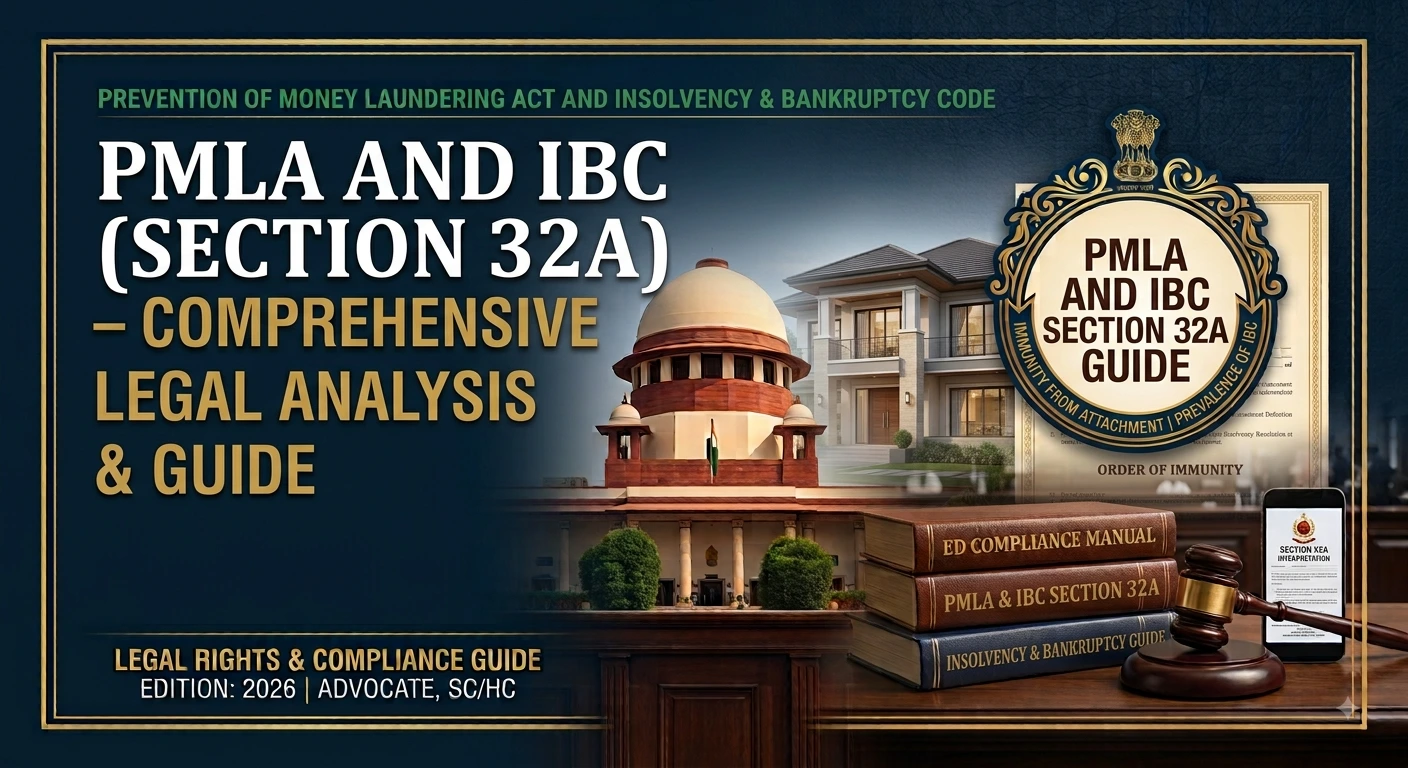
Introduction
Imagine buying a company through insolvency. You pay fair value. You plan to revive it. Then you discover the Enforcement Directorate had attached its assets years ago, for the sins of the old promoters. Do you inherit that problem too?
This is one of the sharpest questions in modern insolvency practice. The answer lies in Section 32A of the Insolvency and Bankruptcy Code, 2016 (IBC). It gives a powerful protection: once a resolution plan is approved, the corporate debtor and its assets get a fresh start, free of past crimes. In this guide, I explain the PMLA–IBC interplay in simple language, using case laws.
For the wider picture of how ED attachment works, you can also read my guide on whether the ED can take your house and other property and my cornerstone guide, Introduction to PMLA and ED Law in India.
The Conflict: Two Laws Pull in Different Directions
The PMLA and the IBC serve very different goals, and they often collide.
The PMLA fights money laundering. It lets the ED attach the “proceeds of crime” and, eventually, confiscate them. The ED naturally wants to hold on to attached assets until the case ends.
The IBC rescues failing companies. It brings in a new owner through a resolution plan, so that jobs, banks, and the economy do not suffer. But no sensible investor will pay good money for a company whose assets could be seized for the previous owner’s crimes.
So the two laws pull against each other. The ED wants to keep the assets attached. The IBC wants to hand them, clean, to a new owner. Section 32A resolves this clash. Let us see how.
What Section 32A Actually Says
Section 32A was inserted into the IBC in 2019 to settle exactly this problem. It has three key parts.
Sub-section (1) says the liability of a corporate debtor for an offence committed before the insolvency process began ceases once a resolution plan is approved. There is one condition: the plan must result in a change of management or control to a person who was not a promoter, not in charge earlier, and not a related party — in short, a genuinely new and clean owner.
Sub-section (2) protects the property of the corporate debtor. It bars any action against that property in connection with an offence committed before the insolvency process, once the plan is approved and the property vests in the new owner.
Sub-section (3) keeps a check in place. The corporate debtor and others must still fully assist any investigation into the earlier offence.
Read together, these provisions create what everyone now calls the “clean slate”. The company and its assets step out of the shadow of past crime, while the guilty individuals stay exposed.
The Leading Case: Manish Kumar v. Union of India
The constitutional validity of Section 32A was challenged, and the Supreme Court settled it in Manish Kumar v. Union of India, (2021) 7 SCC 359. The Court upheld Section 32A in full.
The reasoning is worth understanding, because it drives every later ruling. The Court held that the provision is “born out of experience”. Resolution applicants were reluctant to bid when they feared inheriting the old company’s criminal baggage. To make resolution work, and to protect banks and other stakeholders, it made sense to extinguish the corporate debtor’s prior liabilities once a clean new owner took over.
At the same time, the Court drew a firm line. The immunity protects the corporate debtor and its assets. It does not protect the promoters, directors, or others who actually committed the offence. Their criminal liability continues to haunt them. The company gets a clean slate; the wrongdoers do not. You can read the full judgment on Indian Kanoon.
How Section 32A Meets PMLA Attachment
Now to the practical question. What happens to an ED attachment over the corporate debtor’s assets once a resolution plan is approved?
The logic is straightforward. Attachment under the PMLA is only an interim step. Its purpose is to preserve the property for eventual confiscation after a conviction. But Section 32A stops the corporate debtor from being prosecuted for the prior offence. With no prosecution, there can be no conviction. With no conviction, there can be no confiscation. And if confiscation can never happen, the attachment cannot go on forever in a vacuum. So the attachment must fall away.
Tribunals and courts have applied exactly this reasoning. The National Company Law Appellate Tribunal (NCLAT), in the Alchemist Infra Realty matter, held that a PMLA provisional attachment order ceases to operate by virtue of Section 32A once the resolution plan is approved. Importantly, the successful resolution applicant does not even need to run to the PMLA authorities to seek release. The attachment ends automatically, and the assets can be included in the resolution plan.
Earlier, in the Bhushan Power and Steel line of cases, the NCLAT had already held that the ED’s attachment of a corporate debtor’s assets, after the insolvency process, could not stand once Section 32A applied. These rulings built the foundation on which the higher courts have since acted.
The Bombay High Court Confirms It (2025)
A very important recent ruling has strengthened this position. In 2025, the Bombay High Court, in a judgment by Justice Somasekhar Sundaresan, held that the immunity under Section 32A prevails over prior ED attachments once a resolution plan is approved.
The Court’s reasoning is clear and useful. Since Section 32A prevents the corporate debtor’s conviction, and therefore prevents confiscation, the ED attachment cannot continue. The immunity is automatic upon plan approval; the resolution applicant need not pursue separate PMLA remedies for the corporate debtor’s assets. The Court also held that the NCLT was right to apply Section 32A under its powers, and that the ED was duty-bound to comply with the law as declared by the Supreme Court in Manish Kumar.
This ruling gives resolution applicants real comfort. It confirms, at the level of a High Court, that a clean buyer takes the company’s assets free of the old ED attachment.
What Section 32A Does NOT Do
It is just as important to know the limits of this protection. Section 32A is a shield for the company, not for the criminal.
The guilty individuals stay liable. Promoters, directors, and others responsible for the offence continue to face ED action, prosecution, and attachment of their own personal assets. The clean slate never washes their hands.
Related-party buyers get nothing. If the new owner is a promoter, an old manager, or a related party, Section 32A does not apply. The protection exists only for a genuinely independent, clean acquirer. This condition prevents the guilty from buying back their own company to escape liability.
Assistance is still required. The corporate debtor and others must cooperate fully with any ongoing investigation into the earlier offence.
Personal or non-corporate assets are outside it. The immunity covers the corporate debtor’s property. It does not reach the separate personal properties of the accused, which the ED can still pursue under the ordinary PMLA route. On that front, the usual protections apply, which I explain in my guide on third-party challenges to ED attachment.
Why This Matters for Investors and Lenders
For resolution applicants, banks, and stressed-asset investors, Section 32A changes the risk calculation completely.
A clean buyer can now bid for a distressed company without fearing that the ED will later seize its assets for the old promoter’s laundering. Lenders recover more, because assets are not locked up indefinitely by attachment. And the whole insolvency process becomes more attractive, which is exactly what Parliament intended.
That said, timing and structure are everything. The protection depends on a valid, approved resolution plan and a genuine change of control. Getting the plan right, and the sequence right, needs careful legal work. This is where PMLA knowledge and IBC knowledge must come together.
A Practical Checklist for Resolution Applicants
From experience, here is what a clean applicant should keep in mind when ED attachment shadows a target company:
- Check for existing ED attachments early in due diligence, and map them to the corporate debtor’s assets.
- Confirm a genuine change of control — ensure you are not a promoter, related party, or connected to the old management, or Section 32A will not apply.
- Build Section 32A protection into the plan — record the clean-slate position clearly in the resolution plan and the NCLT approval order.
- Rely on automatic cessation — after approval, the attachment ceases by law; you need not separately petition the ED for the corporate debtor’s assets.
- Keep cooperating with investigators, as Section 32A(3) requires.
- Separate the individuals’ liability — remember the ED can still pursue the old promoters personally, and structure accordingly.
For any ED-side issues that touch individuals connected to the company, the wider PMLA process still applies — from ED summons under Section 50 to arrest under Section 19 and bail. A full map of the case law is in my PMLA case laws digest.
Frequently Asked Questions (FAQ)
Q1. Does Section 32A of the IBC override PMLA attachment? Yes, to a defined extent. Once a resolution plan is approved and control passes to a clean, unrelated person, Section 32A gives the corporate debtor immunity for prior offences, and courts have held that ED attachments over its assets then cease to operate.
Q2. What is the clean slate principle? It means a resolution applicant takes over the company free of its past criminal liabilities, so investors are not scared away. The company and its assets are protected, while the guilty individuals remain liable.
Q3. Do the promoters also get protection under Section 32A? No. Section 32A protects the corporate debtor and its assets, not the promoters, directors, or others responsible for the offence. They continue to face prosecution.
Q4. Does the resolution applicant have to ask the ED to lift the attachment? No. Tribunals have held that the attachment ceases automatically on plan approval, and the ED must comply. The applicant need not chase the PMLA authorities.
Q5. Which is the leading judgment on Section 32A? Manish Kumar v. Union of India (2021), where the Supreme Court upheld the validity of Section 32A and explained the clean slate principle.
Q6. Does Section 32A apply if a promoter buys back the company? No. The protection applies only where control passes to a genuinely independent, unrelated person. A promoter or related-party buyer cannot use Section 32A.
Q7. Are personal properties of the accused protected too? No. Section 32A covers the corporate debtor’s assets. The ED can still pursue the separate personal assets of the individuals involved.
Conclusion
Section 32A of the IBC solves a real and difficult clash between rescuing companies and fighting financial crime. The Supreme Court in Manish Kumar upheld it, the NCLAT applied it to PMLA attachments, and the Bombay High Court has now confirmed that the clean-slate immunity prevails over prior ED attachment. The message is clear. A genuine, clean resolution applicant takes the company’s assets free of the old attachment — while the individuals who committed the offence remain fully answerable.
- Fugitive Economic Offenders Act, 2018: Meaning, Process, Confiscation, and Case Laws

- FEMA vs PMLA: The Key Differences Between the ED’s Two Laws
- PMLA Guide: The Complete Guide to Money Laundering Law, ED Powers, and Your Rights in India

- PMLA Compliance for Reporting Entities: KYC, Record-Keeping, and STRs Under Section 12

- PMLA and IBC: How Section 32A Protects a Corporate Debtor’s Assets from ED Attachment
- Can the ED Take Your House? PMLA Attachment, Possession, and Confiscation Explained

- What to Do If the ED Contacts You: A Step-by-Step Survival Guide

- Scheduled Offences Under PMLA

- Anticipatory Bail in PMLA Cases: Law, the Section 45 Twin Conditions, and How to Get It
- PMLA Case Laws Digest: 50+ Landmark Supreme Court and High Court Judgments on Money Laundering

- Trial Before the PMLA Special Court: Prosecution Complaint, the Section 24 Reverse Burden, Sanction, and Disclosure

- Adjudicating Authority and Appellate Tribunal Under the PMLA: Show-Cause Notices, Section 8 Adjudication, and Appeals Under Sections 26 & 42

- Search and Seizure Under Sections 17 & 18 PMLA: ED Raids and Your Rights — A Practitioner’s Guide

- Proceeds of Crime and Scheduled Offences Under the PMLA: Definition, the Schedule, and the Nexus Requirement

- Arrest Under Section 19 PMLA: Grounds of Arrest, Remand, and Remedies — What to Do in the First 24 Hours

- ECIR Explained: ECIR vs FIR, Can You Get a Copy, and Can It Be Quashed? A Practitioner’s Guide

- Received an ED Summons Under Section 50 PMLA? Rights, Duties, and How to Respond – A Practitioner’s Guide

- How Third Parties With Legitimate Interests Can Contest Attachment Under the PMLA by the ED

- Introduction to Money Laundering, PMLA and ED Law in India: A Complete Guide

- Quashing of Criminal Proceedings by the Delhi High Court: Law, Tests, Landmark Case Laws and Procedure

- Leading Case Laws on ED and PMLA Matters: Landmark Supreme Court Judgments Every Practitioner Must Know

- Bail in PMLA Cases: Supreme Court and Delhi High Court — Complete Guide (2026)