Introduction
Many clients reach lawyer holding an ED notice and one big worry: “Am I going to be arrested?” The answer often depends on a fact most people miss. The Enforcement Directorate enforces two very different laws — FEMA and the PMLA — and they carry completely different consequences.
One is civil. The other is criminal. One usually ends in a monetary penalty you can settle. The other can lead to arrest, attachment of property, and confiscation. So the first question in any ED matter is simple but vital: which law are you actually facing? This guide answers that, in plain language, using verified law.
For the full picture of the criminal side, you can also read my cornerstone guide: Introduction to PMLA and ED Law in India.
The ED Wears Two Hats
The Enforcement Directorate works under the Department of Revenue, Ministry of Finance. It enforces three financial laws, but two dominate its work:
- FEMA — the Foreign Exchange Management Act, 1999. This is a civil law. It regulates foreign exchange and cross-border money flows. It replaced the old, harsh FERA in 2000.
- PMLA — the Prevention of Money Laundering Act, 2002. This is a criminal law. It punishes money laundering and lets the State confiscate the proceeds of crime.
The ED also enforces the Fugitive Economic Offenders Act, 2018, for big-ticket absconders. But for most people and businesses, the question comes down to FEMA versus PMLA. So let us compare them properly.
FEMA Is Civil. PMLA Is Criminal. That Changes Everything.
This single difference drives everything else, so grasp it first.
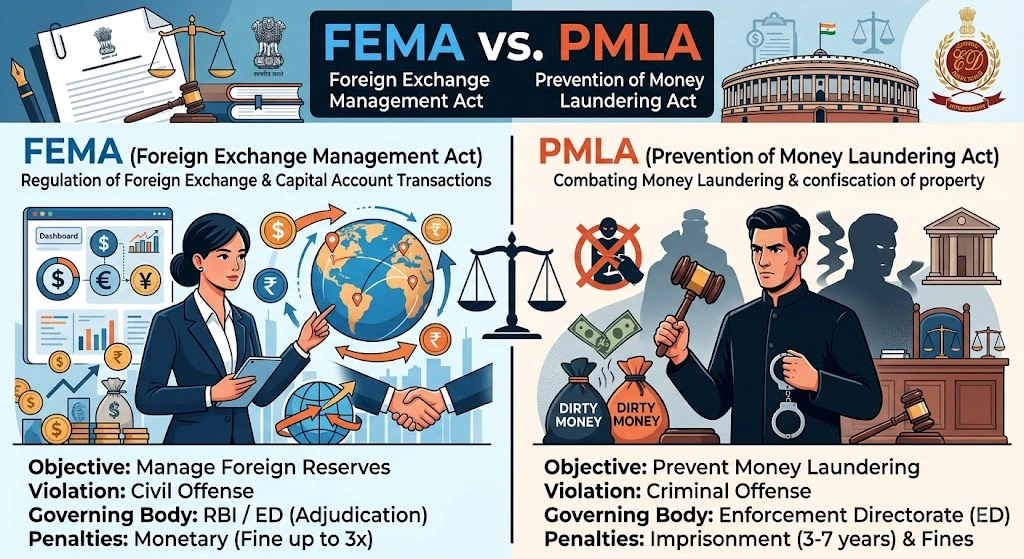
FEMA is a civil, regulatory law. When India liberalised its economy after 1991, it moved away from treating foreign-exchange breaches as crimes. FEMA reframed them as civil contraventions. The usual result of a FEMA breach is a monetary penalty, not jail. Imprisonment can follow only if you fail to pay the penalty.
PMLA is a criminal law. Money laundering is an offence. On conviction, it carries rigorous imprisonment of three to seven years, plus a fine. In serious cases, the term goes higher. The ED can also arrest, attach, and confiscate.
So the two laws sit in different worlds. FEMA is about regulation and penalty. PMLA is about crime and punishment. Everything that follows flows from this divide.
The Triggers: What Sets Each Law in Motion
The two laws start for different reasons.
FEMA starts with a foreign-exchange contravention. Examples include delayed or wrong reporting of foreign investment, mispricing shares in a cross-border deal, holding foreign assets without disclosure, or breaching the rules on outward remittance. FEMA does not need any underlying crime. The contravention itself is enough.
PMLA starts with a scheduled offence. The PMLA needs a predicate crime — a “scheduled offence” listed in the Act — that generates proceeds of crime. Without that scheduled offence and those proceeds, the ED has no jurisdiction under the PMLA. I explain this foundation in my guides on proceeds of crime and scheduled offences and the complete list of scheduled offences.
This difference matters hugely. A pure FEMA breach — say, a late filing on a foreign investment — is not a crime and cannot, on its own, become a money-laundering case.
The Powers: Penalty vs Arrest
Here the gap becomes stark, and this is what clients fear most.
Under FEMA, the ED cannot arrest you. Its powers are civil. It can summon you under Section 37, investigate, and seize property equivalent to the contravention under Section 37A. At the end, an Adjudicating Authority can impose a penalty of up to three times the amount involved. But there is no power of arrest under FEMA.
Under the PMLA, the ED has criminal powers. It can summon you under Section 50, conduct searches under Sections 17 and 18, attach property under Section 5, and — most seriously — arrest under Section 19. On conviction, the property is confiscated.
So if your matter is purely a FEMA matter, the fear of arrest is largely misplaced. If it is a PMLA matter, arrest is a real possibility, and you must prepare for it.
Settlement: Compounding Under FEMA vs the Hard Road Under PMLA
The two laws also differ sharply in how you can close a case.
FEMA allows compounding. Compounding is a settlement route. You admit the contravention, and you pay a compounding fee to close the matter without a long fight. The RBI and the ED handle compounding under FEMA. For many businesses, a FEMA breach discovered early can be compounded for a modest fee, avoiding a large penalty. This is a huge practical advantage.
The PMLA has no easy settlement. Money laundering is a serious offence. There is no simple compounding route. The case runs its course before a Special Court, with the strict Section 45 bail conditions in the background. The road is far longer and harder.
This is why characterising your matter correctly, at the very start, changes everything. A matter that can be compounded under FEMA should never be allowed to drift into PMLA territory through careless handling.
Adjudication and Appeals: Two Different Tracks
The forums differ too.
FEMA matters go before an Adjudicating Authority under FEMA, with appeals to the Appellate Tribunal for Foreign Exchange, and then to the High Court on questions of law. It is a civil-style process throughout.
PMLA matters split into two tracks. The property track goes before the PMLA Adjudicating Authority and the Appellate Tribunal, which I explain in my guide on the Adjudicating Authority and Appellate Tribunal. The criminal track goes before a Special Court, as I explain in my guide on the trial before the PMLA Special Court.
When a FEMA Matter Becomes a PMLA Matter
Here lies the real danger, and the reason the two laws are so often confused.
A FEMA contravention by itself is not a scheduled offence. So it cannot, on its own, trigger the PMLA. But problems arise when the same conduct involves something more. If the foreign-exchange dealing is tied to a scheduled offence — say, fraud, cheating, corruption, or round-tripping of criminal money — then the ED can open a separate PMLA case alongside the FEMA matter. The FEMA breach becomes evidence in a larger money-laundering story.
This is why I always tell clients with cross-border exposure to separate the two early. Handle the FEMA issue as a civil, compoundable matter where possible. And make sure nothing in the conduct gives the ED a hook to allege a scheduled offence and proceeds of crime. Careful, early characterisation is the whole game.
The 2025 Ruling That Reins In the ED
A recent judgment confirms this boundary, and every business with foreign dealings should know it.
In R.K.M Powergen Private Limited v. The Assistant Director, 2025 LiveLaw (Mad) 244, the Madras High Court delivered a strong ruling on 15 July 2025. The ED had frozen fixed deposits worth about ₹901 crore under Section 17(1A) of the PMLA, linked to alleged irregularities in a coal-block matter and alleged FEMA violations, including “round-tripping” of funds.
A Division Bench of Justices M.S. Ramesh and V. Lakshminarayanan quashed the freeze. The Court held that the ED can act under the PMLA only where a scheduled offence and proceeds of crime exist. It famously observed that the ED is not a “super cop” empowered to investigate any activity that comes to its notice. Crucially for our topic, the Court underlined that a FEMA violation is not a scheduled offence under the PMLA, so a forex breach alone cannot support a PMLA freeze.
The principle: a FEMA contravention, standing alone, cannot become a money-laundering case. The ED needs a genuine scheduled offence and real proceeds of crime. This ruling is a powerful shield for businesses facing an overreaching PMLA action built on a mere FEMA breach.
FEMA vs PMLA — A Simple Comparison
To sum up, here are the key differences at a glance:
- Nature: FEMA is civil and regulatory. PMLA is criminal.
- Subject: FEMA covers foreign-exchange contraventions. PMLA covers money laundering of proceeds of crime.
- Trigger: FEMA needs only a contravention. PMLA needs a scheduled offence and proceeds of crime.
- Arrest: No arrest under FEMA. Arrest is possible under Section 19 of the PMLA.
- Main consequence: A monetary penalty (up to three times the amount) under FEMA. Imprisonment, attachment, and confiscation under the PMLA.
- Settlement: Compounding is available under FEMA. There is no easy settlement under the PMLA.
- Forum: FEMA Adjudicating Authority and the Appellate Tribunal for Foreign Exchange. PMLA Adjudicating Authority, Appellate Tribunal, and a criminal Special Court.
- Summons: Section 37 under FEMA. Section 50 under the PMLA.
Which Notice Have You Received? Why It Matters
If the ED has contacted you, the first job is to identify the law. Read the notice carefully. A notice under Section 37 of FEMA points to a civil, foreign-exchange matter. A notice or summons under Section 50 of the PMLA points to a criminal, money-laundering matter.
Getting this right at the start shapes your entire response. A FEMA matter may be resolved calmly through compliance and, if needed, compounding. A PMLA matter demands careful criminal-defence strategy from day one. Either way, do not ignore the notice, do not destroy documents, and get legal advice early. I explain the practical first steps in my guide on what to do if the ED contacts you.
Sometimes a single ED action touches both laws. In those cases, the two defences must run in parallel — a civil strategy under FEMA and a criminal strategy under the PMLA — carefully coordinated so that one does not damage the other.
Frequently Asked Questions (FAQ)
Q1. What is the main difference between FEMA and PMLA? FEMA is a civil law about foreign exchange, ending in monetary penalties that can often be compounded. The PMLA is a criminal law about money laundering, with arrest, attachment, and confiscation. Both are enforced by the ED.
Q2. Is FEMA civil or criminal? FEMA is civil. A contravention leads to a penalty, not jail. Imprisonment can follow only on failure to pay. The PMLA, by contrast, is criminal, with three to seven years’ imprisonment.
Q3. Can the ED arrest me under FEMA? No. FEMA gives no power of arrest. It allows summons, investigation, seizure of equivalent property under Section 37A, and penalties. Arrest exists only under Section 19 of the PMLA.
Q4. Can a FEMA violation turn into a PMLA case? Not by itself. A FEMA contravention is not a scheduled offence. But if the same conduct also involves a scheduled offence generating proceeds of crime, the ED can open a separate PMLA case.
Q5. What is compounding under FEMA? It is a settlement route. You admit the contravention and pay a compounding fee to close the matter, avoiding long litigation. There is no equivalent easy settlement under the PMLA.
Q6. Can the ED freeze my assets just for a FEMA breach? Not under the PMLA. In R.K.M Powergen (2025), the Madras High Court quashed a large PMLA freeze, holding that a FEMA violation is not a scheduled offence and cannot support a PMLA action without proceeds of crime.
Q7. I received an ED notice. How do I know which law applies? Check the section quoted. Section 37 points to FEMA (civil). Section 50 points to the PMLA (criminal). A lawyer can quickly assess the notice and the likely exposure.
Conclusion
FEMA and the PMLA are both enforced by the ED, but they are worlds apart. FEMA is civil, forgiving, and often compoundable. The PMLA is criminal, serious, and hard-fought. The danger lies in confusion — treating a compoundable FEMA breach carelessly, or panicking over a FEMA notice as if arrest were coming. And, as the Madras High Court confirmed in 2025, a FEMA breach alone cannot become a money-laundering case.
- Fugitive Economic Offenders Act, 2018: Meaning, Process, Confiscation, and Case Laws

- FEMA vs PMLA: The Key Differences Between the ED’s Two Laws
- PMLA Guide: The Complete Guide to Money Laundering Law, ED Powers, and Your Rights in India

- PMLA Compliance for Reporting Entities: KYC, Record-Keeping, and STRs Under Section 12

- PMLA and IBC: How Section 32A Protects a Corporate Debtor’s Assets from ED Attachment

- Can the ED Take Your House? PMLA Attachment, Possession, and Confiscation Explained

- What to Do If the ED Contacts You: A Step-by-Step Survival Guide

- Scheduled Offences Under PMLA

- Anticipatory Bail in PMLA Cases: Law, the Section 45 Twin Conditions, and How to Get It

- PMLA Case Laws Digest: 50+ Landmark Supreme Court and High Court Judgments on Money Laundering

- Trial Before the PMLA Special Court: Prosecution Complaint, the Section 24 Reverse Burden, Sanction, and Disclosure

- Adjudicating Authority and Appellate Tribunal Under the PMLA: Show-Cause Notices, Section 8 Adjudication, and Appeals Under Sections 26 & 42

- Search and Seizure Under Sections 17 & 18 PMLA: ED Raids and Your Rights — A Practitioner’s Guide

- Proceeds of Crime and Scheduled Offences Under the PMLA: Definition, the Schedule, and the Nexus Requirement

- Arrest Under Section 19 PMLA: Grounds of Arrest, Remand, and Remedies — What to Do in the First 24 Hours

- ECIR Explained: ECIR vs FIR, Can You Get a Copy, and Can It Be Quashed? A Practitioner’s Guide

- Received an ED Summons Under Section 50 PMLA? Rights, Duties, and How to Respond – A Practitioner’s Guide

- How Third Parties With Legitimate Interests Can Contest Attachment Under the PMLA by the ED

- Introduction to Money Laundering, PMLA and ED Law in India: A Complete Guide

- Quashing of Criminal Proceedings by the Delhi High Court: Law, Tests, Landmark Case Laws and Procedure

- Leading Case Laws on ED and PMLA Matters: Landmark Supreme Court Judgments Every Practitioner Must Know

- Bail in PMLA Cases: Supreme Court and Delhi High Court — Complete Guide (2026)