Introduction
Some economic offenders do not stay to face the music. They flee India, settle abroad, and use distance and money to avoid prosecution for years. For a long time, Indian law struggled to reach them. The Fugitive Economic Offenders Act, 2018 (FEOA) changed that.
The Act gives the State a powerful new weapon. It lets a special court declare a person a “fugitive economic offender” and confiscate their property — even property that has nothing to do with the crime. In this guide, I explain the FEOA in simple language : who it targets, how it works, and the leading cases from Vijay Mallya to Nirav Modi.
The Act is one of three laws the Enforcement Directorate enforces, alongside FEMA and the PMLA. To see how they fit together, read my guides on FEMA vs PMLA and my cornerstone Introduction to PMLA and ED Law in India.
Why the FEOA Was Enacted
The trigger was a series of high-profile scams. Businessmen accused of huge bank frauds – running into thousands of crores – left the country before they could be arrested. Vijay Mallya flew to the UK in 2016. The Nirav Modi–Mehul Choksi Punjab National Bank fraud, worth over ₹13,000 crore, broke in 2018, and both men had already fled.
The old law was weak against absconders. Courts could proclaim a person an “absconder” and attach property under the CrPC, but the process was slow and limited. So Parliament acted. It first brought an Ordinance in April 2018, then passed the Fugitive Economic Offenders Act, 2018. The aim was blunt: stop offenders from escaping justice by fleeing, and hit them where it hurts – their assets.
Who Is a Fugitive Economic Offender?
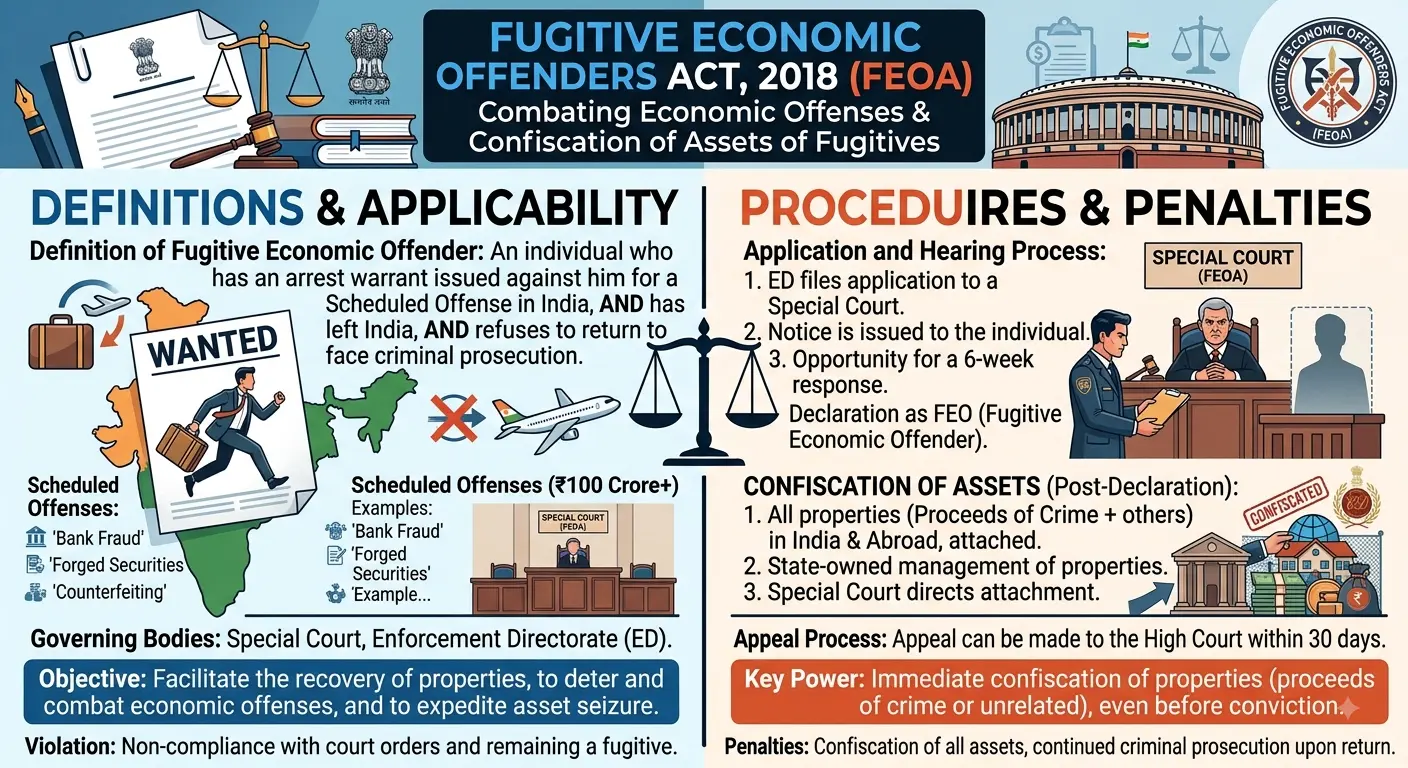
Section 2(f) of the Act defines the term. A fugitive economic offender (FEO) is a person against whom an arrest warrant has been issued for a scheduled offence, and who either:
- has left India to avoid criminal prosecution, or
- being abroad, refuses to return to India to face criminal prosecution.
But there is a crucial threshold. The Act applies only where the total value involved in the scheduled offence is one hundred crore rupees or more. This is deliberate. The FEOA targets big-ticket offenders, not ordinary accused. The “scheduled offences” are listed in the Schedule to the Act, and cover serious economic crimes – bank fraud, cheating, forgery, money laundering, and the like.
So three things must come together: a warrant, a scheduled offence worth ₹100 crore or more, and flight from justice.
The Step-by-Step Process Under the FEOA
The Act sets out a clear procedure, driven by the Enforcement Directorate and decided by a Special Court (the same courts designated under the PMLA). Here is how it works.
Step 1 — Application (Section 4). The Director or an authorised officer of the ED files an application in the Special Court to declare a person a fugitive economic offender. The application lists the properties to be confiscated and the person’s whereabouts.
Step 2 — Attachment (Section 5). The ED can attach the property even before or during the process, to stop it being sold or moved. Attachment can cover proceeds of crime and other property.
Step 3 — Notice (Section 10). The Special Court issues a notice to the person, requiring them to appear at a specified place and date, at least six weeks away. If the person appears in person, the application ends.
Step 4 — Declaration (Section 12). If the person does not appear, the Special Court, after being satisfied and recording reasons in writing, declares the person a fugitive economic offender.
Step 5 — Confiscation (Section 12). On declaration, the court can order that the person’s property stands confiscated to the Central Government.
The powers of survey, search, and seizure under the Act broadly mirror those under the PMLA, which I explain in my guide on ED raids and search and seizure.
The Two Most Powerful Provisions
Two features make the FEOA far more fearsome than ordinary law. Every person with cross-border exposure should understand them.
1. Confiscation beyond proceeds of crime (Section 12). Under the PMLA, the ED can confiscate only the proceeds of crime. The FEOA goes much further. Once a person is declared an FEO, the court can confiscate the proceeds of crime and any other property owned by the offender – including personal and benami property, in India or abroad, whether or not it is linked to the crime. On confiscation, all rights in the property vest in the Central Government, free of encumbrances. This is a drastic power, and it is the Act’s sharpest tooth.
2. The bar on civil claims (Section 14). This is the Act’s most unusual provision. Once a person is declared an FEO, any court or tribunal may disallow that person from filing or defending any civil claim. The bar can even extend to a company or LLP where the promoter, key managerial person, or majority shareholder is an FEO. In simple terms, the fugitive loses the right to use Indian civil courts. The logic is that a person who runs from justice should not be allowed to selectively invoke the same courts they are avoiding.
The Constitutional Debate Around the FEOA
The FEOA’s powers have raised real constitutional questions, and it is fair to note them.
Critics argue that confiscating property beyond the proceeds of crime may violate Article 14, because there is no clear link between seizing unrelated assets and the object of the Act. Others argue that the Section 14 bar on civil claims may violate Article 21. A Constitution Bench of the Supreme Court, in Anita Kushwaha v. Pushap Sudan, (2016) 8 SCC 509, held that access to justice is a fundamental right under Articles 14 and 21. Barring even a fugitive from all civil remedies sits uneasily with that principle.
The courts have so far balanced these concerns against the need to make absconders answerable. As we will see, they have generally required the fugitive to submit to Indian jurisdiction before they can challenge the very Act they are accused of evading.
Leading Cases Under the FEOA
The Act has been tested mainly through the high-profile cases that inspired it. Here are the key ones, with verified facts.
Vijay Mallya — the first FEO. In January 2019, a special PMLA court in Mumbai declared Vijay Mallya the first fugitive economic offender under the Act. Mallya, wanted over the collapse of Kingfisher Airlines and default of around ₹9,000 crore, had left India for the UK in 2016. His challenges have repeatedly run into a wall. In March 2023, the Supreme Court dismissed his plea against the FEO proceedings for non-prosecution, after his counsel said he was receiving no instructions. In December 2025, the Bombay High Court made the position plain: it would not hear his challenge to the FEO declaration or to the Act’s validity until he submits to Indian jurisdiction and returns to face the case.
Nirav Modi — the second FEO. A special court declared jeweller Nirav Modi a fugitive economic offender, the second under the Act, in the context of the roughly ₹13,000 crore Punjab National Bank fraud. He, his relatives, and Mehul Choksi had left India before the scam surfaced.
The wider picture. The Act has been used steadily since. As the Government informed Parliament, by late 2025, 15 persons had been declared fugitive economic offenders, together owing banks over ₹58,000 crore. The message is clear: fleeing no longer protects the offender’s assets.
Sanjay Bhandari – the access-to-justice question. More recently, proceedings involving arms consultant Sanjay Bhandari before the Delhi High Court revived the debate under Section 14 — whether a person who deliberately avoids Indian courts can still invoke their protection. The courts continue to work out this balance between access to justice and respect for the judicial process.
How the FEOA Connects to the PMLA
The FEOA does not stand alone. In practice, it works hand-in-hand with the PMLA. The same Special Courts hear both. The same Enforcement Directorate drives both. And a fugitive is very often already an accused in a PMLA case, with an ECIR, attachment, and a prosecution complaint already on foot.
So a person facing serious economic charges who then flees can find themselves hit on two fronts at once – the PMLA machinery I explain across my guides on arrest under Section 19, attachment, and the Special Court trial, plus the far harsher confiscation of the FEOA. The lesson is simple: fleeing does not end a case. It makes it worse.
Appeals Under the FEOA
The Act does provide a remedy. Under Section 17, an appeal lies from a judgment or order of the Special Court to the High Court, on both facts and law. The appeal must be filed within 30 days, extendable to a maximum of 90 days for sufficient cause. But this remedy, too, is shaped by the courts’ insistence that a fugitive should ordinarily submit to jurisdiction before seeking relief.
What This Means in Practice
For anyone with serious cross-border exposure, the FEOA carries a stark practical message. Leaving India to avoid an economic-offence case is not an escape. It can convert a defendable prosecution into a sweeping confiscation of all your assets, close the doors of the civil courts to you, and leave your challenges unheard until you return.
The wiser course, always, is to face the process within India, defend the case on its merits, and use the safeguards the law provides. Those facing the early stages of an ED matter should read my guide on what to do if the ED contacts you, and on the strict but real remedies of bail and anticipatory bail in PMLA cases.
Frequently Asked Questions (FAQ)
Q1. Who is a fugitive economic offender? Under Section 2(f), a person against whom an arrest warrant has been issued for a scheduled offence involving at least ₹100 crore, and who has left India to avoid prosecution or refuses to return to face it.
Q2. What is the minimum amount under the FEOA? ₹100 crore or more. The Act targets big-ticket economic offenders, not small cases.
Q3. What happens after a person is declared an FEO? The Special Court can confiscate the person’s property to the Central Government — proceeds of crime and any other property, in India or abroad — and the person can be barred from civil claims.
Q4. Who was the first fugitive economic offender in India? Vijay Mallya, declared by a special PMLA court in Mumbai in January 2019. Nirav Modi was the second.
Q5. Can property unrelated to the crime be confiscated? Yes. Unlike the PMLA, the FEOA allows confiscation of any property owned by the offender, not only the proceeds of crime.
Q6. Can a fugitive economic offender fight the case in court? The Act allows appeals under Section 17, but courts have generally required the person to submit to Indian jurisdiction and return before their challenges are heard.
Q7. Which agency enforces the FEOA? The Enforcement Directorate, before the same Special Courts that hear PMLA cases.
Conclusion
The Fugitive Economic Offenders Act, 2018 was born out of frustration — with offenders who fled abroad and used wealth and distance to escape justice. It answers that with force. A declared fugitive can lose all their property, not just the proceeds of crime, and can be shut out of the civil courts. The cases of Vijay Mallya, Nirav Modi, and others show the Act in action, and the courts’ firm stance that a fugitive must return to be heard.
The law is a strong deterrent, but it also raises genuine constitutional questions that the courts continue to weigh.
- Fugitive Economic Offenders Act, 2018: Meaning, Process, Confiscation, and Case Laws

- FEMA vs PMLA: The Key Differences Between the ED’s Two Laws

- PMLA Guide: The Complete Guide to Money Laundering Law, ED Powers, and Your Rights in India

- PMLA Compliance for Reporting Entities: KYC, Record-Keeping, and STRs Under Section 12

- PMLA and IBC: How Section 32A Protects a Corporate Debtor’s Assets from ED Attachment

- Can the ED Take Your House? PMLA Attachment, Possession, and Confiscation Explained

- What to Do If the ED Contacts You: A Step-by-Step Survival Guide

- Scheduled Offences Under PMLA

- Anticipatory Bail in PMLA Cases: Law, the Section 45 Twin Conditions, and How to Get It

- PMLA Case Laws Digest: 50+ Landmark Supreme Court and High Court Judgments on Money Laundering

- Trial Before the PMLA Special Court: Prosecution Complaint, the Section 24 Reverse Burden, Sanction, and Disclosure

- Adjudicating Authority and Appellate Tribunal Under the PMLA: Show-Cause Notices, Section 8 Adjudication, and Appeals Under Sections 26 & 42

- Search and Seizure Under Sections 17 & 18 PMLA: ED Raids and Your Rights — A Practitioner’s Guide

- Proceeds of Crime and Scheduled Offences Under the PMLA: Definition, the Schedule, and the Nexus Requirement

- Arrest Under Section 19 PMLA: Grounds of Arrest, Remand, and Remedies — What to Do in the First 24 Hours

- ECIR Explained: ECIR vs FIR, Can You Get a Copy, and Can It Be Quashed? A Practitioner’s Guide

- Received an ED Summons Under Section 50 PMLA? Rights, Duties, and How to Respond – A Practitioner’s Guide

- How Third Parties With Legitimate Interests Can Contest Attachment Under the PMLA by the ED

- Introduction to Money Laundering, PMLA and ED Law in India: A Complete Guide

- Quashing of Criminal Proceedings by the Delhi High Court: Law, Tests, Landmark Case Laws and Procedure

- Leading Case Laws on ED and PMLA Matters: Landmark Supreme Court Judgments Every Practitioner Must Know

- Bail in PMLA Cases: Supreme Court and Delhi High Court — Complete Guide (2026)