Quashing of Income Tax Reassessment under Section 148 by High Court

This article provides a comprehensive guide to the law of reassessment under Sections 147–151 of the Income Tax Act, 1961, and explains how High Courts—especially the Delhi High Court—have been quashing Section 148 notices on grounds of limitation, invalid sanction, procedural lapses, and lack of jurisdiction. It offers a structured overview of the statutory framework, the reassessment procedure after the Finance Act 2021 & 2024, and landmark case law shaping today’s reassessment jurisprudence.
Special Leave Petition in Supreme Court: Law and Practice.

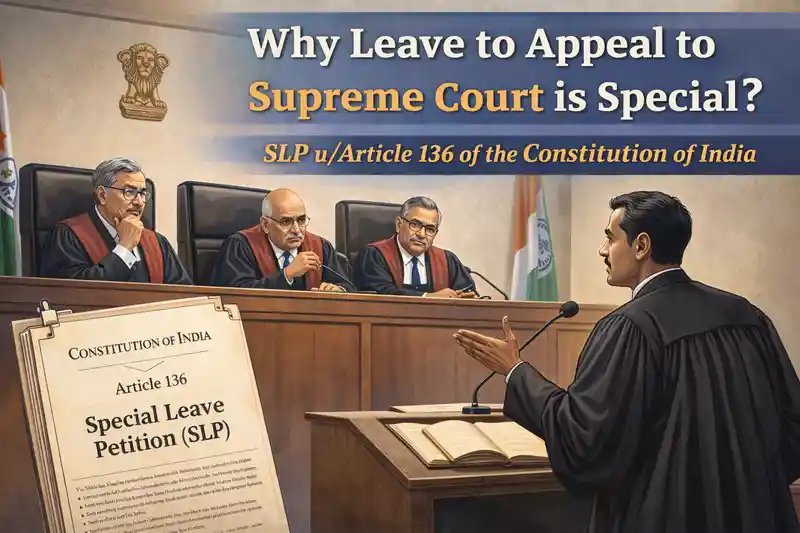
Lawyer arguing before judges for special leave to appeal under Article 136 — Supreme Court of India SLP concept.

This article explains why leave to appeal to the Supreme Court under Article 136 is considered extraordinary. It traces the history, discretionary nature, and judicial principles that make the Special Leave Petition a unique constitutional safeguard against injustice

The Origin and History of Special Leave to Appeal to the Supreme Court of India

History and origin of Article 136 - Special leave Petition

This article traces the historical evolution of the Supreme Court’s discretionary power of special leave under Article 136 — from the royal prerogative of the King-in-Council and Privy Council practice to the Government of India Act 1935, Constituent Assembly debates, and early Supreme Court jurisprudence. It explains how this extraordinary appellate jurisdiction developed as a constitutional safety valve to remedy grave injustice and address questions of law of public importance.

Affidavit in Supreme Court of India; A practical Guide

Affidavit in Supreme Court of India

An affidavit in the Supreme Court of India is a solemn, verified declaration of facts forming the evidentiary foundation of petitions and applications. This guide explains the law, drafting requirements, verification standards, execution procedure, registry scrutiny, common defects, and key Supreme Court rulings governing affidavits under Order IX of the Supreme Court Rules, 2013.

Application of UP Apartment Act

Application of UP Apartment Act Section 2 – scope and applicability explained

Section 2 of the Uttar Pradesh Apartment Act, 2010 sets the foundation for when the Act becomes mandatory. It applies automatically to any building or cluster with four or more apartments—whether on freehold or leasehold land—and safeguards ownership, common areas, and governance rights of apartment owners. This post explains the scope, exclusions such as malls and multiplexes, application to mixed-use and leasehold projects, and the judicial principles shaping its interpretation.

Extent and Commencement of UP Apartment Act

UP Apartment Act commentary extent and commencement

A clear and structured commentary on Section 1 of the Uttar Pradesh Apartment (Promotion of Construction, Ownership and Maintenance) Act, 2010. This post explains the short title, territorial extent, commencement by notification, key judicial interpretations, and the practical impact on promoters, apartment owners, and associations, along with concise FAQs for quick reference.

Introduction to the UP Apartment Law

Apartment Law Uttar Pradesh

This article provides a structured introduction to the Uttar Pradesh Apartment Act, 2010, explaining how the law shapes ownership, common areas, association governance, promoter obligations, and the rights of apartment owners across major urban centres like Noida, Greater Noida, Ghaziabad, Lucknow, and other cities. It also traces key judicial developments and underscores why a dedicated apartment law is essential for modern high-rise living.

Notice u/ Section 35(3) BNSS: New Safeguards Against Arrest

Section 35(3) BNSS notice of appearance safeguard against arrest under new criminal law

Section 35(3) BNSS introduces a modern safeguard against unnecessary arrest by requiring police to issue a notice of appearance when custody is not needed. This article explains the legal rights, procedural protections, key Supreme Court rulings, and the practical steps you must follow after receiving such a notice, along with remedies against misuse.

Quashing of Criminal Proceedings u/s 528 BNSS by Higher Court: Supreme Court’s Four-Step Test & Grounds Explained

quashing of criminal case in India under section 482 CrPC or 528 BNSS or Article 226 of the Constitution of India.

The Supreme Court’s 2025 ruling in Pradeep Kumar Kesarwani v. State of U.P. clarifies when High Courts can quash criminal proceedings under Section 482 CrPC and Section 528 BNSS. This article explains the Court’s structured four-step test, revisits the Bhajan Lal principles, and provides a practical, litigation-oriented guide for lawyers seeking quashing before the High Courts and Supreme Court.

Narco-Analysis Constitutionality in India: 2025 Supreme Court Ruling on Consent, Rights, and Legal Admissibility Explained.

narco analysis in India - almesh v state of bihar

The Supreme Court’s 2025 ruling in Amlesh Kumar v. State of Bihar reaffirms that narco-analysis, polygraph and brain-mapping tests cannot be used without free and informed consent. The judgment clarifies that such techniques cannot be ordered during bail hearings, cannot form the sole basis of conviction, and are not an absolute right for the accused. By reiterating the principles laid down in Selvi v. State of Karnataka (2010), the Court strengthens constitutional protections under Articles 20(3) and 21 and sets clear limits on the use of coercive investigative methods.

Apartment Ownership in Uttar Pradesh: UP Apartment Act 2010, Rules 2011 & Model Bye-Laws Explained

A concise guide to the UP Apartment Act 2010, the accompanying Rules, and the Model Bye-Laws that govern apartment ownership and association management in Uttar Pradesh. This post explains the legal framework, rights of owners, duties of promoters, and the governance structure of Apartment Owners’ Associations, helping residents and AOAs understand compliance, transparency, and effective community management.