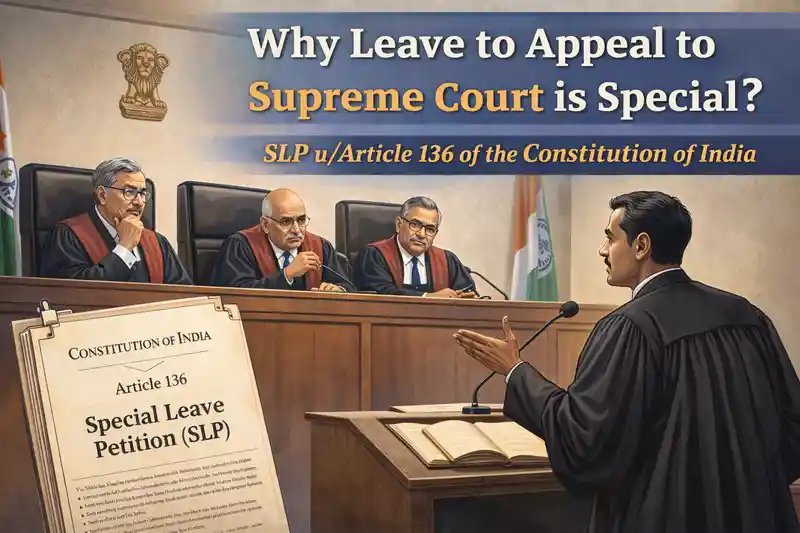
Introduction
To error is human. But to correct an error is greater human.
Article 136, positioned in Part V of the Constitution of India under the chapter dealing with the Union Judiciary, reads as follows:
“136. Special leave to appeal by the Supreme Court.—
(1) Notwithstanding anything in this Chapter, the Supreme Court may, in its discretion, grant special leave to appeal from any judgment, decree, determination, sentence or order in any cause or matter passed or made by any court or tribunal in the territory of India.
(2) Nothing in clause (1) shall apply to any judgment, determination, sentence or order passed or made by any court or tribunal constituted by or under any law relating to the Armed Forces.”
Why leave to appeal to Supreme Court is special
The question “why leave to appeal to Supreme Court is special” lies at the heart of understanding Article 136. Unlike ordinary statutory appeals, this constitutional provision creates a unique mechanism that serves as the ultimate safeguard against miscarriage of justice in the Indian legal system.
Historical origins and constitutional intent
The concept of special leave has existed since long. The expression “special leave to appeal” finds its genesis in the Government of India Act, 1935, where it appeared in Sections 110, 205, 206, and 208. Under that regime, “special leave” was granted by His Majesty-in-Council through the Judicial Committee of the Privy Council.[1]
During the Constituent Assembly debates on what was then Draft Article 112 (which later became Article 136), deliberations took place on 6th June 1949 and 16th October 1949. The framers envisioned a powerful constitutional tool enabling the apex court to deliver ultimate justice, unconstrained by the rigid procedural limitations of ordinary appeals.[2]
The residuary and extraordinary character
Article 136 is a non obstante provision, commencing with the words “Notwithstanding anything in this Chapter.” This overriding nature is precisely why leave to appeal to Supreme Court is special—even within the field covered by Articles 132 to 134 (which prescribe specific appellate jurisdictions), the jurisdiction conferred by Article 136 remains available to be exercised in an appropriate case.[3]
The appellate jurisdiction exercised by the Supreme Court is conferred by Articles 132 to 136 of the Constitution. Articles 132, 133, and 134 provide when an appeal thereunder would lie and when not. Article 136, however, is a special jurisdiction conferred on the Supreme Court which is sweeping in its nature. It is a residuary power in the sense that it confers an appellate jurisdiction on the Supreme Court subject to the special leave being granted in such matters as may not be covered by the preceding articles.
As observed by the Constitution Bench in Pritam Singh v. State, the points to be noted regarding this Article are: firstly, that it is very general and is not confined merely to criminal cases; secondly, that the words used are “in any cause or matter,” while those used in Articles 132 to 134 are “civil, criminal or other proceeding”; and thirdly, that while in Articles 132 to 134 reference is made to appeals from the High Courts, under this Article, an appeal will lie from any court or tribunal in the territory of India.[4]
Discretionary, not appellate as of right
A critical feature explaining why leave to appeal to Supreme Court is special is its discretionary character. The Article does not confer a right to appeal upon any party; it only confers a discretion upon the Supreme Court to grant or refuse leave to appeal. An aggrieved party cannot claim special leave to appeal under Article 136 as a matter of right—it is a privilege vested in the Supreme Court of India.[5]
As eloquently stated in N. Suriyakala v. A. Mohandoss:
“Article 136 cannot be read as conferring a right on anyone to prefer an appeal to this Court; it only confers a right on a party to file an application seeking leave to appeal and a discretion on the Court to grant or not to grant such leave in its wisdom. When no law confers a statutory right to appeal on a party, Article 136 cannot be called in aid to spell out such a right.”[6]
The power under Article 136 has been described as an “untrammeled reservoir of power incapable of being confined to definitional bounds; the discretion conferred on the Supreme Court being subjected to only one limitation, that is, the wisdom and good sense or sense of justice of the Judges.”[7]
Plenary nature of the power
Article 136 is worded in the widest terms possible. It vests in the Supreme Court a plenary jurisdiction in the matter of entertaining and hearing of appeals by granting special leave against any kind of judgment or order made by a Court or Tribunal in any cause or matter.[8]
In Mathai @ Joby v. George, a Constitution Bench upheld this expansive reach, holding that “no effort should be made to restrict the powers of this Court under Article 136 because while exercising its powers under Article 136 of the Constitution of India, this Court can, after considering facts of the case to be decided, very well use its discretion. In the interest of justice, it would be better to use the said power with circumspection, rather than to limit the power forever.“[9]
The two-stage nature of jurisdiction
A significant constitutional elucidation came through the landmark decision in Kunhayammed v. State of Kerala, where a three-Judge Bench of the Supreme Court held that the jurisdiction conferred by Article 136 is divisible into two stages:[10]
- First stage: Up to the disposal of prayer for special leave to file an appeal; and
- Second stage: Commences if and when the leave to appeal is granted and the special leave petition is converted into an appeal.
This distinction is of paramount importance. The Supreme Court cannot reverse or modify the decree or order appealed against while deciding a petition for special leave to appeal. What is impugned before the Supreme Court can be reversed or modified only after granting leave to appeal and then assuming appellate jurisdiction over it.
Principles evolved by the Supreme Court for entertaining SLPs
Understanding why leave to appeal to Supreme Court is special requires examining the self-imposed limitations the Court has developed over decades.
Exceptional circumstances and substantial questions of law
The foundational principle, established in Pritam Singh v. State (1950), is that the Supreme Court should not interfere with the decisions of the High Court except in exceptional circumstances. The Court held that “this discretion must be exercised judiciously, permitting appeals only when ‘exceptional and special circumstances’ are present, and where ‘substantial and grave injustice’ has been manifestly demonstrated.”[11]
The Supreme Court invokes this power in exceptional circumstances as and when:
- A question of law of general public importance arises;
- Substantial questions of law requiring interpretation of the Constitution are involved;
- Gross injustice has been done; or
- There is a gross miscarriage of justice.
Not a regular court of appeal
The Supreme Court would not under Article 136 constitute itself into a tribunal or court just settling disputes and reduce itself to a mere court of error. The power under Article 136 is an extraordinary power to be exercised in rare and exceptional cases.[12]
Limited interference with concurrent findings of fact
The Supreme Court refrains from interfering with concurrent findings of fact recorded by the courts below unless there are significant legal or procedural errors.[13]
Principles in criminal matters
In Rajesh Prasad v. State of Bihar, the Court outlined principles guiding its intervention in acquittal orders under Article 136:[14]
- An intervention is warranted when the High Court’s approach or reasoning is deemed perverse;
- When the High Court, based on suspicion and surmises, rejects evidence;
- When the acquittal is primarily rooted in an exaggerated adherence to the rule of giving benefit of doubt;
- When the acquittal would lead to a significant miscarriage of justice.
Principles in civil matters
Special Leave Petition in civil cases will generally not be granted unless:
- There is a substantial question of law involved;
- The issue affects the interest of the general public;
- There is a gross miscarriage of justice.
Against what kind of orders can SLP be preferred
The scope of Article 136 encompasses “any judgment, decree, determination, sentence or order in any cause or matter passed or made by any court or tribunal in the territory of India.”
Final and interlocutory orders
Article 136 applies to both final and interlocutory orders. However, the Supreme Court is generally reluctant to interfere with purely interlocutory orders unless they cause irreparable injury or result in gross injustice.[15]
From any court or tribunal
Appeals shall lie from orders of:
- High Courts (in civil, criminal, and constitutional matters);
- District Courts and Sessions Courts;
- Tribunals
- Quasi-judicial authorities invested with judicial power of the State;[16]
- Arbitration proceedings (after exhausting remedies under the Arbitration Act).
The armed forces exclusion
Article 136(2) explicitly excludes judgments, determinations, sentences, or orders passed by courts or tribunals constituted under laws relating to the Armed Forces.[17]
Procedural aspects and limitation
Chapter XVI of the Supreme Court Rules, 2013 provides for the appellate procedure:
- Limitation Period: SLP can be filed within 90 days from the date of judgment/order/decree, or within 60 days against the High Court’s order refusing certificate of fitness for appeal.
- Filing Requirements: The petition shall be in Form No. 28 and filed through an Advocate-on-Record (AOR).
- Condonation of Delay: The Supreme Court has discretion to condone delay if sufficient cause is shown.
Effect of dismissal of SLP and the doctrine of merger
The Kunhayammed judgment comprehensively addressed the implications of SLP dismissal:[18]
- Dismissal by Non-Speaking Order: Does not constitute res judicata, and the doctrine of merger does not apply.
- Dismissal with Reasons: While there is no merger, the rule of judicial discipline and Article 141 are attracted. The reasons become the law declared by the Supreme Court.
As clarified in Smt. Tej Kumari v. CIT, when a special leave petition is dismissed, the Court does not comment on the correctness or otherwise of the order from which leave to appeal is sought.[19]
Frequently asked questions
Q1: Why is leave to appeal to Supreme Court special under Article 136?
Answer: Leave to appeal to Supreme Court is special because it is not a right but a constitutional privilege. Unlike ordinary appeals, Article 136 grants discretionary power to the Supreme Court to hear cases involving substantial questions of law, gross injustice, or matters of public importance, even when no statutory appeal exists. This is why leave to appeal to Supreme Court is special—it serves as the ultimate safety valve in the Indian judicial system.
Q2: What is the difference between SLP and regular appeal?
Answer: A regular appeal is a statutory right conferred by law, whereas SLP under Article 136 is a constitutional remedy that is purely discretionary. The Supreme Court is not bound to hear every SLP and can reject it without giving reasons. This discretionary nature is central to understanding why leave to appeal to Supreme Court is special.
Q3: Within how many days can SLP be filed?
Answer: SLP can be filed within 90 days from the date of judgment/order of a Court or Tribunal, or within 60 days against the High Court’s order refusing to grant certificate of fitness for appeal to Supreme Court.
Q4: Can SLP be filed against interlocutory orders?
Answer: Yes, Article 136 applies to both final and interlocutory orders. However, the Supreme Court is generally reluctant to interfere with purely interlocutory orders unless they cause irreparable injury or result in gross injustice.
Q5: Against which orders can SLP not be filed?
Answer: Under Article 136(2), SLP cannot be filed against judgments, determinations, sentences, or orders passed by courts or tribunals constituted under laws relating to the Armed Forces.
Q6: Does dismissal of SLP mean the High Court order is affirmed?
Answer: No. If SLP is dismissed by a non-speaking order, it does not constitute affirmation of the High Court’s order, nor does the doctrine of merger apply. It simply means the Supreme Court chose not to exercise its discretionary jurisdiction.
Q7: Can review be filed in High Court after SLP is dismissed?
Answer: Yes, if SLP is dismissed at the threshold without granting leave, the petitioner can still file a review petition before the High Court. The alternative remedy is not lost.
Conclusion
Article 136 stands as one of the most significant provisions in the Indian Constitution, and understanding why leave to appeal to Supreme Court is special is fundamental to comprehending our constitutional scheme. The provision embodies the constitutional trust reposed in the Supreme Court, that it will exercise this extraordinary power with circumspection, guided solely by the demands of justice.
The power under Article 136 is, as aptly described, an overriding power where under the Court may generously step in to impart justice and remedy injustice. At the same time, it is an exceptional power to be exercised sparingly, with caution and care, only to remedy extraordinary situations occasioning gross failure of justice.
Through decades of judicial pronouncements, the Supreme Court has evolved a rich jurisprudence around this provision, laying down principles for its exercise while steadfastly refusing to limit its expansive scope. The fundamental objective remains constant: ensuring that no injustice goes unaddressed and that the Supreme Court, as the guardian of the Constitution, has the means to fulfill its sacred duty of dispensing justice.
This is precisely why leave to appeal to Supreme Court is special, it represents the constitutional commitment to justice that transcends procedural limitations.
Footnotes and citations
[1] The Government of India Act, 1935, Section 208 addressed appeals to His Majesty-in-Council, permitting appeals with special leave in various matters.
[2] Constituent Assembly Debates on Draft Article 112, dated 6th June 1949 and 16th October 1949.
[3] Kunhayammed v. State of Kerala, (2000) 6 SCC 359 at para 13.
[4] Pritam Singh v. State, AIR 1950 SC 169; (1950) SCR 453.
[5] State of Maharashtra v. Jagmohan Singh Kuldip Singh Anand, (2004) 7 SCC 659.
[6] N. Suriyakala v. A. Mohandoss, (2007) 9 SCC 196.
[7] Kunhayammed v. State of Kerala, (2000) 6 SCC 359.
[8] Union Carbide Corporation v. Union of India, (1991) 4 SCC 584 at para 58.
[9] Mathai @ Joby v. George, (2016) 7 SCC 700.
[10] Kunhayammed v. State of Kerala, (2000) 6 SCC 359 at paras 42-44.
[11] Pritam Singh v. State, AIR 1950 SC 169.
[12] N. Suriyakala v. A. Mohandoss, (2007) 9 SCC 196; Bihar Legal Support Society v. Chief Justice of India, (1986) 4 SCC 767.
[13] Ganga Kumar Srivastava v. State of Bihar, (2005) 6 SCC 211; Dalbir Kaur v. State of Punjab, (1976) 4 SCC 158.
[14] Rajesh Prasad v. State of Bihar, (2022) 3 SCC 471.
[15] Ganesh Trading Co. v. Moji Ram, (1978) 2 SCR 614; Ashok Nagar Welfare Association v. R.K. Sharma, AIR 2002 SC 335.
[16] Tirupati Balaji Developers Pvt. Ltd. v. State of Bihar, AIR 2004 SC 2351.
[17] Constituent Assembly Debates, 16th October 1949; Union of India v. Maj. Gen. Madan Lal Yadav, (1996) 4 SCC 127.
[18] Kunhayammed v. State of Kerala, (2000) 6 SCC 359.
[19] Smt. Tej Kumari v. CIT, (2001) 247 ITR 210.
Read more on Supreme Court
- Appeal to Supreme Court Against Order of NCLAT – National Company Law Appellate Tribunal
- Article 32 Writ Petition in the Supreme Court of India: Law, Procedure, and Complete Guide
- Fundamental Rights Provided by the Constitution of India and Expanded by the Supreme Court
- Advocate on Record (AOR) in the Supreme Court of India: Role, Eligibility, Exam & Complete Guide
- Transfer Petition in the Supreme Court of India: Law, Grounds, and Landmark Case Laws
- Curative Petition in the Supreme Court of India: Innovation, Jurisprudence, and Practice
- How to Draft a Special Leave Petition Under Article 136 That Survives the Admission Stage
- Special Leave Petition in Supreme Court: Law and Practice.

- The Origin and History of Special Leave to Appeal to the Supreme Court of India
- Affidavit in Supreme Court of India; A practical Guide
- Quashing of Criminal Proceedings u/s 528 BNSS by Higher Court: Supreme Court’s Four-Step Test & Grounds Explained
- Caveat Filing in Supreme Court: Meaning, Procedure, Format & 90-Day Rules

- Transfer Petition in the Supreme Court: Complete Procedure, Grounds & FAQs

- Review Petition in the Supreme Court of India: Article 137, Order XLVII, Grounds, Procedure & Landmark Cases
- The Supreme Court Rules, 2013

- Effect of Dismissal of Special Leave Petition by Supreme Court and Doctrine of Merger

- Matrimonial Case Transfer to Another State: Supreme Court Jurisdiction, Procedure & Case Law

- When and how to initiate contempt proceedings before High Court?

- The second appeal shall be heard ONLY on the substantial question(s) of law framed by the High Court under Section 100 (4) of the CPC.
- Magistrate suo-moto cannot pass an order for further investigation in a criminal case.