

This article answers every question about forming and registering an AOA in Delhi. You will know the law, the steps, the documents, and the authorities. After reading this, you can register an AOA yourself.
Introduction
Millions of people live in multi-storeyed buildings in Delhi. Yet, most of their housing management societies are not legally registered. Legally, management societies of multi-storied housing societies are called apartment owners’ association. Without a registered Association of Apartment Owners (AOA), residents have no collective legal voice.
A registered AOA can take over common areas from the builder. It can collect maintenance, maintain the greenery, common areas and facilities, upgrade facilities, represent owners in court, and enforce rights under the Delhi Apartment Ownership Act, 1986. An unregistered group has none of these powers.
This article is a one-stop guide on AOA formation and registration in Delhi. Here, I have covered the law, the judicial interpretation, and a complete step-by-step process for formation and registration of AOA in Delhi. Whether you are a apartment owner, a promoter, or a lawyer, this guide is for you.
For a foundational understanding of the parent statute, read my article: Delhi Apartment Ownership Act, 1986 — A Complete Legal Guide for Flat Owners in Delhi.
Legal Framework
The Delhi Apartment Ownership Act, 1986 (Act No. 58 of 1986) is the primary legislation. It was passed by Parliament and came into force on 1st December 1987. The Act extends to the entire Union Territory of Delhi.
The Act has six chapters and twenty-seven sections. Section 15 is the governing provision for the AOA. It mandates the creation of an Association of Apartment Owners for every multi-storeyed building.
The Central Government notified the Delhi Apartment Ownership Rules, 1987 on 17th November 1987. Model Bye-Laws were notified along with the Rules. These three instruments — the Act, the Rules, and the Model Bye-Laws — form the complete legal framework for AOA formation and governance.
1. Why the Act Requires an AOA
The Act recognises that apartment owners collectively own the common areas. Someone must manage those areas. Parliament chose the apartment owners themselves as that body apparently because it will safeguard the interests of the apartment owners better. Section 15(1) says: there shall be an Association of Apartment Owners.
This is a mandatory provision, not a discretionary one. The word ‘shall’ makes it obligatory. Courts have consistently held that formation of the AOA cannot be indefinitely deferred.
Section 15(1), Delhi Apartment Ownership Act, 1986: ‘There shall be an Association of Apartment Owners for the administration of the affairs in relation to the apartments and the property appertaining thereto and for the management of common areas and facilities.’
2. What Is an AOA?
2.1 Meaning of the Association
Under Section 3(f) of the Act, the Association of Apartment Owners means all the owners of the apartments in a multi-storeyed building acting as a group in accordance with the bye-laws.
Where multiple buildings exist in a designated block or pocket, there shall be only one AOA for all buildings in that block. This prevents fragmentation of governance and ensures unified management.
2.2 Powers of the AOA
The AOA derives its authority from the Act and the Model Bye-Laws. Its powers are substantial. They include all of the following.
- Exclusive right to maintain, repair, and replace common areas and facilities.
- Power to collect common expenses from all apartment owners proportionately.
- Authority to retain commercial portions of the building and lease them out.
- Power to distribute common profits to apartment owners.
- Authority to build a reserve fund from common profits.
- Power to advance short-term loans to members in emergency situations.
- Right to bring suits in court on behalf of two or more apartment owners.
- Right of access to every apartment for emergency repairs.
- Power to frame and enforce rules of conduct for all residents.
2.3 Board of Management
The AOA governs its affairs through a Board of Management. Under the Model Bye-Laws, the Board consists of a President, Vice-President, Secretary, and Treasurer. All of them are elected by apartment owners. The Board is the executive arm of the AOA. It can appoint a Estate Manager and delegate powers to the Manager. The Board must hold at least two regular meetings every year.
3. Why Registration Matters
3.1 Registration Gives Legal Identity
An unregistered AOA has no legal standing. It cannot sue or be sued. Without registration an AOA cannot sign contracts. It also cannot open bank accounts in the name of the association. Further, it cannot represent owners in disputes with the builder.
Registration under the Societies Registration Act, 1860 gives the AOA a distinct legal personality. From the date of registration, the AOA can do everything a legal entity can do beside performing all the functions under the Model Bye-laws.
3.2 Only Registered AOA Can Take Over Common Areas
The transfer of common areas and facilities from the builder to the residents can only happen to a registered AOA. An informal group of residents has no right to demand this transfer. Courts have held that the builder is bound to hand over common areas only to the registered AOA.
3.3 Recovery of Common Expenses
Under Section 21 of the Act, unpaid common expenses are a charge on the apartment. However, only the registered AOA can enforce such charge. Without registration, there is no mechanism to recover dues legally.
3.4 Compliance Under RERA
The Real Estate (Regulation and Development) Act, 2016 (RERA) requires formation of an association of allottees. Under Section 11(4)(e) of RERA, the promoter must facilitate formation within three months of a majority of allottees having booked flats. Registration under the Delhi Apartment Ownership Act provides the necessary legal structure for this compliance.
You can watch my video on formation of Allottees Association under RERA Law.
A registered AOA is not a luxury. It is a legal necessity. Without it, residents have no collective power against builders, governments, or third parties.
4. Who Registers an AOA in Delhi? The Registering Authority
This is a question that confuses many residents. Let us answer it with precision.
An AOA in Delhi is registered as a society under the Societies Registration Act, 1860, as amended in its application to the Union Territory of Delhi. The registering authority is the Registrar of Societies for Delhi.
Competent Authorities Under the Act
The Act separately designates Competent Authorities for performing functions under the Act itself. These authorities are distinct from the Registrar of Societies. Under the O.S. Bajpai judgment (2010), the Delhi High Court directed that the Vice-Chairman of DDA, the Secretary of Delhi Administration, and the L&DO shall each be Competent Authorities. They can further authorise officers of the rank of Deputy Commissioner or Joint Commissioner.
The Competent Authority performs functions such as recording succession, approving the Deed of Apartment, and issuing directions to promoters. The Competent Authority is not the entity that registers the AOA as a society.
Registrar of Societies: The Registration Authority
For the actual registration of the AOA as a legal entity, you must approach the Registrar of Societies. In Delhi, the Registrar of Societies is an officer under the Department of Revenue, Government of NCT of Delhi. The office is located in the respective district of Delhi.
Applications for registration are filed before the Registrar of Societies of the concerned district. The Registrar has the power to register, approve bye-laws, and cancel registrations under the Societies Registration Act, 1860.
The Delhi Government provides online procedure for filing of the application on its portal at: Registration of Society and Non-Government Organization (External Link to Gov. of Delhi.
5. Which Law Governs AOA Registration in Delhi?
Two statutes work in tandem for AOA registration in Delhi. Understanding both is essential.
5.1 Delhi Apartment Ownership Act, 1986
This Act mandates the formation of the AOA. It prescribes the powers, structure, and bye-laws of the AOA. It defines who is an apartment owner, what common areas are, and how management must be conducted.
The Act does not, by itself, provide a registration procedure. It assumes the AOA will be registered under the applicable law for societies. Section 3(j) of the Model Bye-Laws identifies the Registrar of Co-operative Societies. In practice, the AOA is registered under the Societies Registration Act.
5.2 Societies Registration Act, 1860 (as amended for Delhi)
This central Act provides the mechanism for registration of societies in Delhi. Section 1 of the Act requires at least seven persons to subscribe to a Memorandum of Association and file it with the Registrar.
The Delhi Amendment to this Act is relevant. It expands the scope of registrable societies to include welfare societies. An AOA is registered as a welfare society or as an association of apartment owners under this Act. Once registered, it has the rights and protections of a registered society.
5.3 Role of Model Bye-Laws
The Model Bye-Laws framed by the Administrator of Delhi under Section 15(2) of the Act are the governing rules of the AOA. Every AOA must adopt these bye-laws at its first meeting. Any departure from the Model Bye-Laws requires prior approval of the Administrator.
The Bye-Laws cover the title, application, definitions, objects, membership, voting, Board of Management, election of officers, assessments, use of apartments, maintenance, accounts, funds, mortgagees’ rights, compliance, and amendment procedure.
Both the Delhi Apartment Ownership Act and the Societies Registration Act, 1860 must be complied with for a valid AOA formation. Neither alone is sufficient.
6. Trigger for Formation: When Can an AOA Be Formed?
The Act does not specify when the AOA must be formed. This has been a significant gap. It has allowed promoters to delay formation indefinitely.
Courts have addressed this gap. The generally accepted position is that the AOA should be formed when a majority of apartments (more than 50%) have been sold or transferred and residents have taken possession. This is the threshold at which residents have a collective stake in governance.
RERA’s Guidance on Timing
Under Section 11(4)(e) of RERA, the promoter must facilitate formation of an association of allottees within three months of a majority of allottees having booked flats. This provides a clear timeline in RERA-registered projects. For projects not registered under RERA, the 50% occupation standard applies as a guide.
Practical Trigger
In practice, residents should not wait for the builder to act. Once more than half the apartments are occupied, the residents can and should initiate AOA formation. The legal obligation is on both the promoter and the apartment owners.
Important: The Act is silent on who bears the primary obligation to form the AOA. In practice, builders exploit this silence. Do not wait for the builder. Initiate the process yourselves.
7. Landmark Case: O.S. Bajpai v. The Administrator, Delhi High Court
No article on AOA formation in Delhi is complete without this case. It is the most important judicial pronouncement on the subject.
7.1 Background
Mr. O.S. Bajpai, a Senior Advocate, filed a Public Interest Litigation before the Delhi High Court. The PIL was WP(C) No. 1959 of 2007. It brought to light the systematic non-compliance with the Delhi Apartment Ownership Act, 1986 by builders and the inaction of government authorities.
The Delhi High Court pronounced its judgment on 28th May 2010. Justice Rajiv Sahai Endlaw delivered the ruling. The case has become the guiding authority for AOA formation and rights enforcement in Delhi.
7.2 Findings of the Court
The Court found that Deeds of Apartment were not being executed. AOAs were not being formed. Builders were continuing to manage common areas and collecting maintenance charges without any legal authority or accountability. The government had acknowledged these gaps but had done nothing to remedy them.
The Court noted that the Act had no penal provisions. This had been used as an excuse for inaction. The Court stated that absence of penal provisions does not prevent enforcement of the Act through civil remedies.
7.3 Directions Issued by the Court
The Court issued several binding directions. First, Competent Authorities must be appointed area-wise and must function effectively. Second, they may authorise officers of the rank of Deputy Commissioner or Joint Commissioner to perform functions under the Act. Third, the registration of Deeds of Apartment must be expedited.
Fourth, and crucially, the formation of AOAs must be facilitated. The Court held that a time-bound process must be followed for forming AOAs in Delhi. Fifth, upon AOA formation, the builder must hand over common areas, security deposits, and maintenance funds to the AOA.
7.4 Post-Judgment Developments
Even after the O.S. Bajpai judgment, compliance has remained poor in Delhi. A second round of directions was issued subsequently. The Court noted that despite directions, benefits of the Act had not reached apartment owners.
The judgment remains the strongest tool in the hands of apartment owners in Delhi. If a builder refuses to facilitate AOA formation, residents can file a contempt petition or writ petition relying on O.S. Bajpai.
O.S. Bajpai v. The Administrator (WP(C) No. 1959 of 2007, Delhi High Court, 28 May 2010) — This case is the cornerstone of AOA rights enforcement in Delhi. Every resident should be aware of it.
7.5 Other Relevant Case Laws
Association of Apartment Owners of New Delhi House v. Govt. of NCT of Delhi (Civil Suit No. 58332/16)
This case decided by the Senior Civil Judge, New Delhi District, dealt with a dissolution and reconstitution dispute between two competing AOAs. The Court held that there can only be one AOA for a building under Section 15 of the Act. A new AOA cannot be formed unless the earlier one is dissolved under Section 13 of the Societies Registration Act, 1860.
The Court held that dissolution requires votes of not less than three-fifths of the total members. If that threshold is not met, dissolution is void and any subsequently registered AOA has no legal standing.
Dhawan Deep Residents Welfare Asso. (Regd.) vs. M/s. Star Estate Management Ltd.
The Delhi High Court in in this case has inter alia held that the owners/residents of a multi-storeyed building have a right of maintenance of common areas and amenities and the builder/promoter or its agency cannot forcibly recover maintenance charges.
Guru Ram Das Bhawan v. Doon Apartments Pvt. Ltd.
This case stands for an important principle. Upon formation of the AOA, all security deposits collected by the builder must be handed over to the AOA. The builder has no locus to continue managing common services after the AOA is formed. Courts have ordered refund of such deposits with interest.
Nehru Place Hotels Ltd. v. Bhushan Ltd.
The Court held that the builder has no locus to continue maintenance services and charge for them once the AOA is formed. The builder is bound to give full accounts of all maintenance collections. Without transparency, the builder’s claim for maintenance charges fails.
8. How to Form and Register an AOA in Delhi
This is the complete step-by-step process. Follow each step in sequence. Do not skip any step.
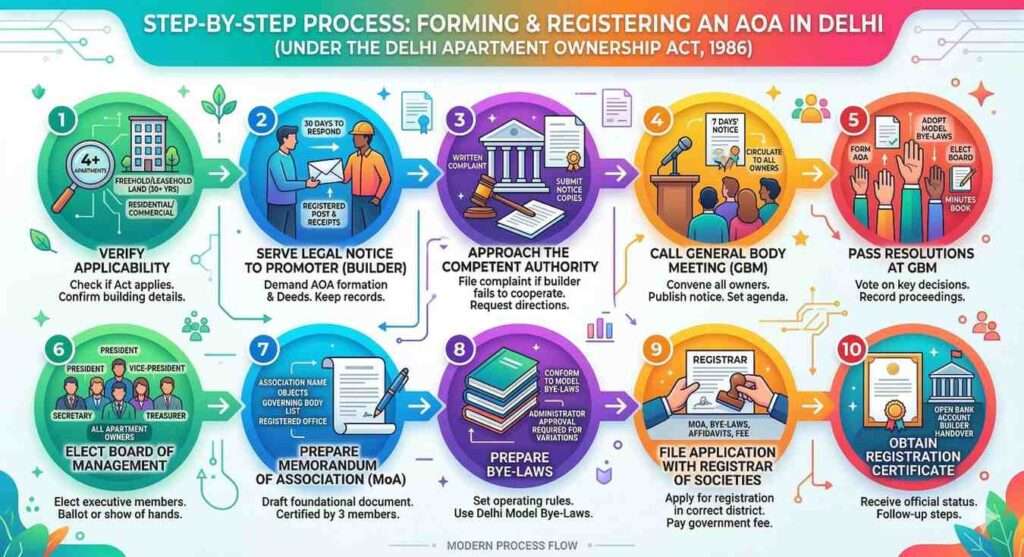
Step 1: Verify Applicability of the Act
Check that the Act applies to your building. The building must be a multi-storeyed building in Delhi with four or more apartments. It must be on freehold or leasehold land of at least 30 years. Construction must be for residential or commercial purposes. Once applicability is confirmed, proceed.
Step 2: Serve a Legal Notice to the Promoter (Builder)
Send a formal legal notice to the builder. The notice should demand formation of the AOA and execution of Deeds of Apartment. Give the builder 30 days to respond. Send the notice by registered post with acknowledgement due. Keep a copy and the postal receipt. This notice creates a legal record. It is essential before approaching the Competent Authority.
Step 3: Approach the Competent Authority
If the builder does not respond or refuses to cooperate, file a written complaint with the Competent Authority. Under the O.S. Bajpai directions, the Competent Authority is obligated to act. Submit copies of the notice served on the builder. Request the Competent Authority to issue directions to the builder for AOA formation. The Competent Authority can issue binding directions.
Step 4: Call a General Body Meeting (GBM)
Convene a General Body Meeting of all apartment owners. Publish a notice of the GBM in the building and circulate it to all apartment owners by letter. Give at least seven days’ notice. The notice must clearly state the agenda: formation of AOA, adoption of Model Bye-Laws, and election of the Board. Ensure a majority of apartment owners is present.
Step 5: Pass Resolutions at the GBM
At the GBM, pass three resolutions. First, a resolution to form the Association of Apartment Owners. Second, a resolution to adopt the Model Bye-Laws notified under the Delhi Apartment Ownership Act, 1986. Third, a resolution to elect the Board of Management. Record the proceedings in a minutes book. Get the minutes signed by the Chairperson of the meeting.
Step 6: Elect the Board of Management
Elect the Board of Management at the GBM. The Board must include a President, Vice-President, Secretary, and Treasurer. All must be apartment owners. The election must be by ballot or show of hands. Record the names, addresses, and vote counts. The Board’s term is as prescribed in the bye-laws. Prepare a list of governing body members with signatures.
Step 7: Prepare the Memorandum of Association (MoA)
Draft the Memorandum of Association. The MoA must contain: the name of the association; the objects of the association (as per Model Bye-Laws); the names, addresses, and occupations of the governing body members; and the place of the registered office. The MoA must be certified by at least three members of the governing body.
Step 8: Prepare Bye-Laws of the Association
Prepare the bye-laws of the association. For an AOA in Delhi, the bye-laws must conform to the Model Bye-Laws framed under Section 15(2) of the Act. No variation is permitted without prior approval of the Administrator. The bye-laws must be certified by at least three members of the governing body as a correct copy.
Step 9: File Application with the Registrar of Societies
File the application for registration with the Registrar of Societies of the concerned district in Delhi. The application must include the Memorandum of Association, certified bye-laws, list of governing body members, proof of registered office, affidavits from founding members, and prescribed registration fee. Pay the government fee as applicable.
Step 10: Obtain Registration Certificate
After scrutiny of documents, the Registrar will issue a Registration Certificate. This certificate gives the AOA its legal identity as a registered society. Keep multiple certified copies. After registration, open a bank account in the AOA’s name. Notify the Competent Authority. Send a notice to the builder demanding handover of common areas.
The entire registration process normally takes 25 to 90 days from filing, depending on the Registrar’s workload and completeness of documents.
9. Documents Required for Registration
The following documents must be submitted to the Registrar of Societies for registration of an AOA in Delhi.
Mandatory Documents
- Memorandum of Association (MoA) — in duplicate, signed by at least seven founding members.
- Certified copy of Bye-Laws — certified by at least three governing body members.
- List of governing body members with names, addresses, occupations, and signatures.
- Minutes of the General Body Meeting at which the AOA was formed.
- Attendance sheet of the founding GBM.
- Affidavit on non-judicial stamp paper by the President or Secretary affirming accuracy of MoA and bye-laws.
- Identity proof of all founding members (Aadhaar, Voter ID, Passport).
- Address proof of all founding members.
- Proof of registered office address (ownership document or tenancy agreement).
- No-Objection Certificate (NOC) from owner of registered office, if on lease.
- Court fee stamp or demand draft for registration fee.
- Any other as sought by the Registrar Office.
Supportive Documents (Recommended)
- Copies of Sale Deeds or Allotment Letters showing apartment owners’ titles.
- Copy of the Deed of Apartment, if executed.
- Copy of the legal notice served on the builder.
- Copy of direction from the Competent Authority, if any.
Tip: All documents must be in the same name. If founding members are co-owners, use the first-named owner’s details. Ensure all photocopies are self-attested. The Registrar may ask for originals for verification.
10. Builder Refusal to Cooperate
Builder non-cooperation is the most common problem in Delhi. Builders delay AOA formation to retain control over maintenance income and common areas. Here is what residents can do.
10.1 Notice and Complaint to Competent Authority
First, serve a registered notice on the builder. Second, file a written complaint with the Competent Authority (DDA Vice-Chairman, Secretary of Delhi Administration, or L&DO). The Competent Authority has been empowered by the O.S. Bajpai judgment to issue directions. This is the primary administrative remedy.
10.2 Writ Petition before Delhi High Court
If the Competent Authority fails to act, residents can file a writ petition under Article 226 of the Constitution. The Delhi High Court has consistently enforced the directions issued in O.S. Bajpai. A writ petition is a powerful tool. Once the High Court issues directions, the builder and the Competent Authority must comply.
10.3 Complaint under RERA
If the project is registered under RERA, residents can also approach the Real Estate Regulatory Authority, Delhi. Under RERA, non-facilitation of AOA formation is a violation. The RERA Authority can impose penalties on the builder and issue directions.
10.4 Civil Suit
Apartment owners can also file a civil suit for a mandatory injunction. The suit can seek a direction to the builder to execute Deeds of Apartment and to cooperate in AOA formation. Courts have granted such injunctions where prima facie violations are established.
Important: Residents can form the AOA and register it even without the builder’s cooperation. The builder’s participation is not legally required for the GBM, election, and registration. The builder’s obligation is to hand over common areas after registration.
For a practical guide on handling builder non-cooperation in comparable situations, read: How to Form an Association of Apartment Owners (UP framework with parallel principles).
11. Post-Registration Compliance: Obligations of the Registered AOA
Registration is only the beginning. A registered AOA has ongoing legal obligations. Non-compliance can lead to cancellation of registration.
11.1 Bank Account and Financial Records
Open a dedicated bank account in the name of the AOA. All receipts and payments must flow through this account. The Treasurer must maintain full and accurate accounts of all receipts and disbursements. A passbook must be maintained for each apartment owner. The AOA must publish an audited financial statement on or before 31st July each year.
11.2 Annual General Meeting
The AOA must hold an Annual General Meeting (AGM) as prescribed in the bye-laws. The Board must be elected at the AGM. Notice of the AGM must be sent to each apartment owner at least seven days but not more than seven days before the meeting. Failure to hold the AGM or conduct elections can lead to disputes and legal challenges.
11.3 Submission of Annual Returns
Under the Societies Registration Act, 1860, every registered society must file annual returns with the Registrar. The returns include the list of governing body members. Failure to file returns for two or more years can result in cancellation of registration.
11.4 Audit
The AOA must appoint an auditor at its general meeting. The auditor is to audit accounts prepared by the Board. Audited accounts must be made available to any member during office hours. A copy must be submitted to the Competent Authority by 15th August of every year.
11.5 Handover of Common Areas
After registration, the AOA must formally demand handover of common areas from the builder. The demand must be in writing, by registered post. The builder is obligated to hand over common areas along with all security deposits, maintenance funds, and accounts. A failure to hand over is a violation that can be enforced in court.
11.6 Maintenance of Only One AOA
There can be only one AOA for a multi-storeyed building or a block. Section 15(1) is explicit. The New Delhi House case confirmed this. Any attempt to form a parallel AOA without dissolving the first one is void. If a dispute arises about which AOA is legitimate, it must be resolved through the Registrar of Societies or the Civil Court.
For a detailed guide on AOA elections and disputes, read: How and Where to Challenge the Election of Society / Board of Management / AOA.
12. Distinction: AOA vs RWA in Delhi
Residents often confuse the AOA with a Resident Welfare Association (RWA). They are different legal entities with different powers.
AOA (Association of Apartment Owners)
An AOA is formed under the Delhi Apartment Ownership Act, 1986. It is mandatory for multi-storeyed buildings covered by the Act. AOA has statutory powers over common areas and facilities. It can enforce maintenance charges as a legal charge on apartments.
RWA (Resident Welfare Association)
A RWA is formed under the Societies Registration Act, 1860 for general welfare purposes. It is not linked to a specific apartment law. RWA has no statutory power over common areas but its just to voluntarily safeguard the interest of residents of a specified area. It cannot enforce maintenance dues as a statutory charge. It is appropriate for plotted developments or colonies not covered by the apartment law.
Which Is Better for Flat Owners in Delhi?
For multi-storeyed buildings covered by the Delhi Apartment Ownership Act, an AOA is always preferable in as much as it is mandatory. The AOA has more authority, stronger legal backing, and specific statutory protections. An RWA is appropriate only where the Act does not apply.
If your building is covered by the Delhi Apartment Ownership Act, form an AOA — not an RWA. The AOA has statutory powers that an RWA simply does not have.
13. Topics for Further Reading
- Delhi Apartment Ownership Act 1986: Law, Deed of Apartment, AOA & Owner Rights | This article give an introduction of the Delhi Apartment Law. Published on March 15, 2026
14. Conclusion
Forming and registering an AOA is not complicated. It requires patience, organisation, and knowledge of the law. This guide has given you both.
The Delhi Apartment Ownership Act, 1986 gives apartment owners a powerful tool. However, the tool works only if residents take initiative. An unregistered, informal group has no legal standing. A registered AOA can demand common areas, enforce maintenance dues, and take the builder to court.
The O.S. Bajpai judgment confirmed that the state must facilitate AOA formation. Wherefore, residents can invoke that judgment if authorities are slow. Courts in Delhi are sympathetic to apartment owners who have followed due process.
As a Supreme Court lawyer practising in apartment law for over a decade, I have seen hundreds of societies struggle for recognition. The struggle is almost always unnecessary. The law gives residents everything they need. The only requirement is to use it.
Follow the ten steps in this article. Form your General Body Meeting. Elect your Board. File your application with the Registrar. Obtain your certificate. Thereafter, take back what is rightfully yours — your common areas, your maintenance funds, and your right to govern your own home and get cured any construction defects in the project.
15. Frequently Asked Questions (FAQs)
Q1. Can an AOA be formed without the Deed of Apartment?
Yes. The formation of the AOA and the execution of Deeds of Apartment are separate processes. The AOA can be formed even if the promoter has not executed Deeds of Apartment and gave possession.
Q2. How many members are needed to register an AOA in Delhi?
At least seven persons must subscribe to the Memorandum of Association under the Societies Registration Act, 1860. However, the AOA’s membership consists of all apartment owners. The seven founding members are the initial signatories, not the limit on total members.
Q3. Can a tenant be a member of the AOA?
Under the Model Bye-Laws, membership of the AOA is for apartment owners. A tenant is not an apartment owner. However, the bye-laws provide for associate membership. Tenants may participate in certain activities but cannot vote in Board elections unless the bye-laws expressly permit it.
Q4. What if there are two competing AOAs in a building?
Section 15 of the Act allows only one AOA per building or block. The New Delhi House case held that a new AOA can be formed only after the earlier one is dissolved under Section 13 of the Societies Registration Act. If two AOAs exist, the matter must be taken to the Registrar of Societies or Civil Court for resolution.
Q5. Can the builder be a member of the AOA?
Under the Model Bye-Laws, the builder becomes a member of the AOA for unsold apartments. The builder’s membership is proportionate to the unsold apartments. Once all apartments are sold, the builder ceases to be a member. The builder does not have any special right to govern the AOA.
Q6. What happens if the AOA fails to hold elections?
Failure to hold elections is a serious governance failure. It can lead to legal challenges under Section 25 of the Societies Registration Act. Aggrieved members can approach the Registrar or the Civil Court. The Court can direct the Registrar to supervise elections. The AOA’s registration is also at risk.
Q7. Can the Registrar cancel the AOA’s registration?
Yes. The Registrar has the power to cancel registration under the Societies Registration Act if the AOA is non-functional, fails to submit annual returns, or violates its own bye-laws. However, cancellation must follow due process, including an opportunity of hearing to the AOA.
Q8. Is stamp duty payable on registration of the AOA?
Section 25 of the Delhi Apartment Ownership Act empowers the Central Government to exempt stamp duty and registration fees on instruments executed by the AOA. Whether an exemption has been granted at a given time should be verified with the current notification. Consult a lawyer to determine the applicable fees.
Q9. Is formation of an AOA mandatory under the Delhi Apartment Ownership Act?
Yes. Section 15 of the Delhi Apartment Ownership Act, 1986 requires every multi-storeyed building to have an Association of Apartment Owners (AOA). The AOA manages common areas, collects maintenance charges, and administers the building on behalf of all apartment owners.
Q10. What is the minimum number of members required to register an AOA in Delhi?
At least seven persons must sign the Memorandum of Association to register an AOA under the Societies Registration Act, 1860. These seven are the founding members. After registration, all apartment owners automatically become members of the AOA.
Q11. Can residents form an AOA without the builder’s consent?
Yes. Apartment owners can form and register an AOA without the builder’s consent. Residents can convene a General Body Meeting, adopt the Model Bye-Laws, elect a Board of Management, and apply for registration before the Registrar of Societies.
Q12. When should an AOA be formed in a housing project?
An AOA is generally formed when more than 50% of the apartments are sold or occupied. Under RERA, the promoter must facilitate formation of an association of allottees within three months of majority bookings.
Q13. Can an AOA open a bank account and collect maintenance charges?
Yes. Once registered, the AOA becomes a legal entity. It can open bank accounts, collect maintenance charges, maintain accounts, enter contracts, and manage finances relating to common areas and facilities.
Q14. What happens to common areas after the AOA is formed?
After the AOA is registered, the builder must hand over control of common areas, security deposits, maintenance funds, and building records to the association. The AOA then becomes responsible for management and maintenance of the property.
Q15. Can the builder continue collecting maintenance after AOA registration?
No. Once the AOA is formed, the builder cannot continue collecting maintenance unless authorised by the association.
Q16. Can there be more than one AOA for a building in Delhi?
No. Section 15 of the Delhi Apartment Ownership Act permits only one Association of Apartment Owners for a building or designated block.
Q17. What is the difference between a Deed of Apartment and an AOA?
A Deed of Apartment records ownership of a specific apartment and the owner’s share in common areas. An AOA is the collective body of all apartment owners responsible for managing common areas and enforcing the building’s bye-laws.
Q18. Can the AOA file legal cases against the builder?
Yes. A registered AOA can initiate legal proceedings against the builder on behalf of apartment owners. This may include cases relating to handover of common areas, recovery of maintenance funds, construction defects, or violation of statutory obligations.
Q19. Can the Registrar refuse to register an AOA?
Yes. The Registrar of Societies may refuse registration immediately if the documents are incomplete or inconsistent with the law. The applicants can correct the deficiencies.
Q20. Can an AOA be dissolved after registration?
No. An AOA registered as a society cannot be dissolved till the condominium exits.
Read more on Delhi Apartment Law