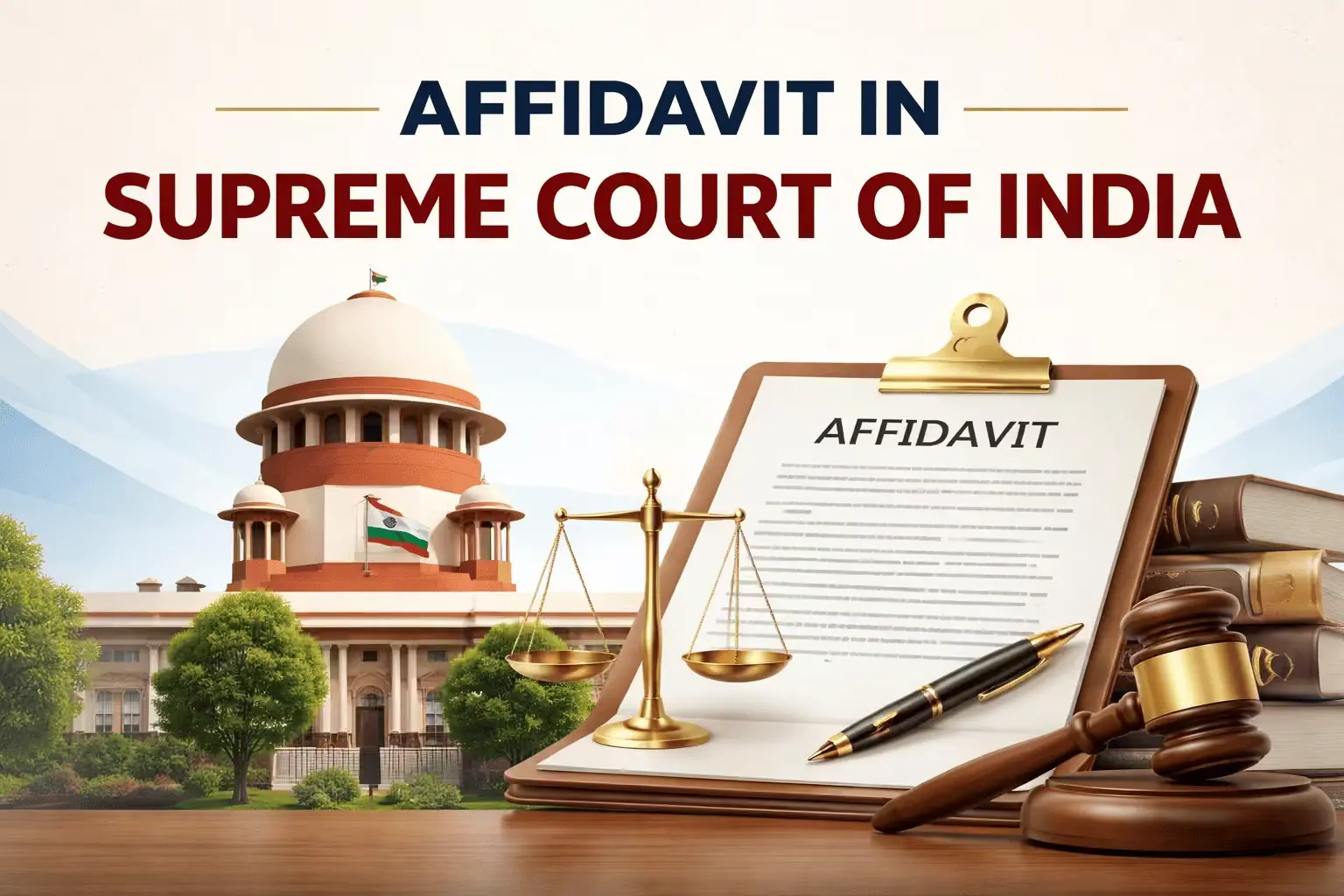
Affidavit in Supreme Court of India: Law, Practice and Procedure for Execution and Filing
An affidavit in the Supreme Court of India is a written statement of facts sworn under oath or affirmation before a legally authorised authority and filed in support of petitions, applications, and pleadings. It is the primary mode of placing facts on record before the Supreme Court and forms the evidentiary foundation of most proceedings. An affidavit is defined under Section 3(3) of the General Clauses Act, 1897 as a statement made voluntarily under oath or affirmation.
In Supreme Court practice, affidavits are not treated as mere procedural formalities. Every petition, SLP, transfer petition, civil appeal, writ petition, review petition or application and almost all pleadings is required to be supported by an affidavit, and the Hon’ble Court relies upon the accuracy, verification, and disclosure of source of information contained therein. A defective, casual, or misleading affidavit may invite registry objections, dismissal of pleadings, or adverse judicial consequences, making strict compliance with the Supreme Court Rules, 2013 (Order IX) indispensable
Supreme Court Rules on Affidavit
The procedure for filing an affidavit in Supreme Court of India is governed by Order IX of the Supreme Court Rules, 2013 read with Section 139 of the Code of Civil Procedure, 1908. Let us first breifly peruse the bare rules:
| Rule Number | Procedural Requirement (In Brief) |
|---|---|
| Order IX Rule 1 | Court may permit proof of facts by affidavit or allow affidavits to be read as evidence, subject to conditions and right of cross-examination. |
| Order IX Rule 2 | Evidence in applications may be given by affidavit, but the Court may direct personal appearance of the deponent for cross-examination. |
| Order IX Rule 3 | Every affidavit must be filed in the specific cause, appeal or matter for which it is sworn. |
| Order IX Rule 4 | Affidavits must be drafted in the first person, divided into consecutively numbered paragraphs, and must state the deponent’s description, occupation (if any), and address. |
| Order IX Rule 5 | Affidavits must be confined to facts within the deponent’s personal knowledge, except in interlocutory applications where belief is permitted with disclosed grounds. |
| Order IX Rule 6 | Where interpretation is required, the affidavit must be interpreted to the deponent by a competent interpreter who must certify correctness. |
| Order IX Rule 7 | Affidavits may be sworn before a Notary Public, authority under Section 139 CPC, Registrar of the Supreme Court, or authorised Oath Commissioner. |
| Order IX Rule 8 | Special procedure prescribed for affidavits sworn by pardahnashin ladies, including oath before a lady officer and proof of identification. |
| Order IX Rule 9 | Every annexure/exhibit to an affidavit must be properly marked, titled, and initialled by the attesting authority. |
| Order IX Rule 10 | Affidavits containing interlineations, alterations or erasures must be duly initialled; otherwise, they are not to be accepted. |
| Order IX Rule 11 | Registrar may refuse affidavits with excessive corrections and require the affidavit to be rewritten. |
| Order IX Rule 12 | Affidavits filed beyond prescribed timelines cannot be relied upon without leave of the Court. |
| Order IX Rule 13 | “Affidavit” includes petitions and pleadings; verification must distinguish statements based on knowledge from those based on information, with disclosure of source. |
Nature and Evidentiary Value of Affidavits in Supreme Court Proceedings
An affidavit filed before the Supreme Court of India is not a mere procedural formality. It constitutes a solemn declaration of facts, sworn under oath, and carries with it serious legal consequences, including exposure to proceedings for perjury in the event of false statements.
While affidavits are routinely accepted as proof of facts for procedural purposes, it is well settled that affidavits are not a substitute for oral evidence in trials unless specifically permitted by law or ordered by the Court. The Supreme Court has consistently held that disputed questions of fact ordinarily cannot be resolved solely on affidavits, particularly where cross-examination is sought and justified.
However, in constitutional, appellate, and interlocutory proceedings, affidavits form the primary evidentiary backbone, and the Court relies heavily on the accuracy, clarity, and completeness of affidavits filed by parties.
Who Can Swear an Affidavit in the Supreme Court?
An affidavit may be sworn by:
- The petitioner/appellant, or a person authorised by him having knowledge of the facts.
- An authorised representative (in case of companies, firms, or institutions),
- A power of attorney holder, where properly authorised,
- An officer of the State or authority competent to depose to the facts.
- Guardian in case of minor.
Registry practice insists that:
- The deponent must be clearly identifiable,
- The authority to swear must be explicitly disclosed, and
- The affidavit must demonstrate the deponent’s competence and source of knowledge.
Execution of Affidavits: Oath, Affirmation and Authority
As per Order IX Rule 7 of the Supreme Court Rules, 2013, affidavits may be sworn before:
- A Notary Public,
- An authority under Section 139 CPC,
- A Registrar of the Supreme Court authorised by the Chief Justice of India,
- An Oath Commissioner authorised by the Chief Justice of India.
The oath or affirmation is not symbolic. The administering authority must:
- Personally witness the deponent signing,
- Verify identity,
- Ensure voluntariness,
- Properly endorse the affidavit with seal, date, and signature.
Any deviation is treated as a serious defect.
Where Can an Affidavit Be Executed?
In short, before any Public Notary.
An affidavit intended to be filed before the Hon’ble Supreme Court of India may be executed either within the precincts of the Supreme Court or at any place where the deponent is physically present at the time of execution. There is no requirement under law that an affidavit must be sworn in Delhi merely because the proceedings are before the Supreme Court.
This position flows from Order IX Rule 7 of the Supreme Court Rules, 2013, read with Section 139 of the Code of Civil Procedure, 1908, which permit affidavits for proceedings before the Supreme Court to be sworn before a Notary Public or any other authority legally empowered to administer oaths, irrespective of the place of execution.
Accordingly, where a deponent ordinarily resides in, or is temporarily present at, a place outside Delh, for example, Bengaluru, the affidavit may validly be executed at that place before a competent authority. An affidavit so executed, when otherwise in conformity with the Supreme Court Rules, 2013, is fully acceptable for filing before the Supreme Court.
Drafting Standards for Affidavits in Supreme Court
1. First Person Narrative
Affidavits must be drafted strictly in the first person (“I say”, “I submit”, “I state”).
2. Paragraphing
- Paragraphs must be numbered consecutively.
- Each paragraph should deal with one factual assertion.
3. Knowledge vs Information
A crucial requirement under Order IX Rule 13 is the clear demarcation between:
- Statements based on personal knowledge, and
- Statements based on information and belief.
Where statements are based on information:
- The source of information must be disclosed,
- Vague phrases such as “I am informed” without source are unacceptable.
Affidavits in Interlocutory Applications
In interlocutory applications statements of belief may be permitted, Provided the grounds of belief are disclosed.
However, even in interlocutory matters, the Supreme Court expects: precision, relevance, avoidance of argumentative or legal submissions in affidavits. Affidavits should state facts, not argue law.
Alterations, Corrections and Interlineations
Under Order IX Rules 10 and 11:
- Any alteration or interlineation must be initialled,
- Excessive corrections may lead to outright rejection by the Registrar,
- Rewriting of affidavits is often insisted upon.
Best practice:
Never file affidavits with handwritten corrections unless unavoidable.
Verification Clause
The verification clause must:
- Clearly specify which paragraphs are true to knowledge,
- Which are based on information,
- Identify the source of such information.
A defective verification renders the affidavit vulnerable to rejection and weakens the pleading substantively.
Consequences of False or Defective Affidavits
Filing a false affidavit before the Supreme Court may attract:
- Proceedings for perjury,
- Adverse judicial observations,
- Dismissal of case;
- Imposition of Cost;
- Registration of Criminal case;
- Loss of credibility before the Court.
The Supreme Court has repeatedly deprecated the practice of casual or misleading affidavits, especially by public authorities.
Case Laws
In Dalip Singh v. State of Uttar Pradesh, (2010) 2 SCC 114, (paras 19 & 21) the Hon’ble Supreme Court held that a litigant who approaches the Court with false statements or misleading affidavits pollutes the stream of justice. Relief can be denied solely on the ground of lack of candour, irrespective of merits.
In Amar Singh v. Union of India, (2011) 7 SCC 69 the Court observed that filing a false affidavit amounts to deliberate deception and may attract proceedings for contempt and perjury. Affidavits are not empty formalities but solemn declarations before the Court in following words:
“65. This court wants to make one thing clear i.e. perfunctory and slipshod affidavits which are not consistent either with Order XIX Rule 3 of the CPC or with Order XI Rules 5 and 13 of the Supreme Court Rules should not be entertained by this Court.
66. In fact three Constitution Bench judgments of this Court in Purushottam Jog Naik (supra), Barium Chemicals Ltd. (supra) and A.K.K. Nambiar (supra) and in several other judgments pointed out the importance of filing affidavits following the discipline of the provision in the Code and the said rules.
67. These rules, reiterated by this Court time and again, are aimed at protecting the Court against frivolous litigation must not be diluted or ignored. However, in practice they are frequently flouted by the litigants and often ignored by the Registry of this Court. The instant petition is an illustration of the same. If the rules for affirming affidavit according to Supreme Court were followed, it would have been difficult for the petitioner to file this petition and so much of judicial time would have been saved. This case is not isolated instance. There are innumerable cases which have been filed with affidavits affirmed in a slipshod manner.
68. This Court, therefore, directs that the Registry must henceforth strictly scrutinize all the affidavits, all petitions and applications and will reject or note as defective all those which are not consistent with the mandate of Order XIX Rule 3 of the CPC and Order XI Rules 5 and 13 of the Supreme Court Rules.”
In A.K.K. Nambiar v. Union of India, AIR 1970 SC 652 the Supreme Court held that affidavits must clearly disclose whether statements are based on personal knowledge or on information and belief. An affidavit that does not disclose the source of information has no evidentiary value.
In Hari Narain v. Badri Das, AIR 1963 SC 1558 it was held that … “it is of utmost importance that in making material statements and setting forth grounds in applications for special leave, care must be taken not to make any statements which are inaccurate, untrue or misleading. In dealing with applications for special leave, the Court naturally takes statements of fact and grounds of fact contained in the petitions at their face value and it would be unfair to betray the confidence of the Court by making statements which are untrue and misleading. That is why we have come to the conclusion that in the present case, special leave granted to the appellant ought to be revoked. Accordingly, special leave is revoked and tile appeal is dismissed. The appellant will pay the costs of the respondent.”
The ruling in N. Eswaranathan v. State (2025 INSC 509) underscores the Court’s insistence that affidavits must contain full and candid disclosure, especially when filed by an Advocate-on-Record who bears a heightened duty to verify facts. The AOR was held responsible because the second SLP was filed without clearly stating that an earlier SLP on the same matter had already been dismissed, a lapse the Court treated as suppression of a material fact and as conduct obstructing the administration of justice. At the same time, the Court adopted a balanced approach: noting the AOR’s immediate and unconditional apology, his otherwise clean professional record, and genuine remorse, it declined to impose harsh consequences. Instead, the Court accepted the apology with a stern warning, reaffirming both the strict standards expected of AORs and the willingness to temper discipline where contrition is sincere.
In Harmanpreet Singh v. State of Punjab, SLP (Crl.) No. 7862/2024 the Court criticised the Registry for accepting a counter-affidavit from a person who was not impleaded as a party without necessary authority or caveats, highlighting procedural rigor required in filing affidavits in the Supreme Court.
Conclusion
An affidavit in Supreme Court of India is not a mere procedural formality but a solemn declaration made before the highest constitutional court. Accuracy, proper verification, disclosure of source of information, and strict adherence to Order IX of the Supreme Court Rules, 2013 are indispensable to effective Supreme Court practice. Defective or casual affidavits not only invite registry objections but may also lead to adverse judicial consequences, including dismissal of pleadings.
For advocates and litigants alike, a clear understanding of the law, practice and procedure governing affidavits ensures procedural compliance, enhances credibility before the Court, and facilitates the efficient administration of justice.
FAQ: Frequently Asked Questions on Affidavits
1. What is an affidavit in Supreme Court proceedings?
An affidavit is a written statement of facts sworn under oath or affirmation before a competent authority and filed in support of petitions, applications, or pleadings before the Supreme Court. It serves as the primary means of placing facts on record.
2. Is filing an affidavit mandatory in the Supreme Court?
Yes. All petitions and applications before the Supreme Court must be supported by affidavits. Pleadings without a supporting affidavit are procedurally defective and liable to be rejected.
3. Where can an affidavit for the Supreme Court be executed?
An affidavit may be executed either in the Supreme Court or at any place where the deponent is present at the time of execution, including outside Delhi, provided it is sworn before a competent authority.
4. Who is authorised to administer oath for Supreme Court affidavits?
Affidavits may be sworn before a Notary Public, an authority under Section 139 of the Code of Civil Procedure, an authorised Oath Commissioner, or a Registrar of the Supreme Court, as per Order IX Rule 7.
5. Can an affidavit be sworn outside Delhi for filing in the Supreme Court?
Yes. There is no requirement that an affidavit must be sworn in Delhi. Affidavits sworn outside Delhi are valid if executed in accordance with law and the Supreme Court Rules, 2013.
6. What are the essential drafting requirements of a Supreme Court affidavit?
An affidavit must be drafted in the first person, divided into numbered paragraphs, confined to facts within the deponent’s knowledge, and must clearly distinguish statements based on personal knowledge from those based on information and belief.
7. Is it necessary to disclose the source of information in an affidavit?
Yes. Where statements are based on information or belief, the source of such information must be clearly disclosed. Failure to do so renders the affidavit unreliable and may attract registry objections.
8. Can affidavits replace oral evidence in Supreme Court proceedings?
No. Affidavits are not a substitute for oral evidence where disputed questions of fact arise, unless the statute or the Court specifically permits proof by affidavit.
9. What are the consequences of filing a false or misleading affidavit?
Filing a false or misleading affidavit may result in dismissal of the petition, adverse judicial observations, initiation of contempt proceedings, or prosecution for perjury.
10. What are the most common affidavit-related defects noticed by the Supreme Court Registry?
Common defects include improper verification, absence of source of information, uninitialled annexures, defective attestation, excessive corrections, and affidavits sworn by unauthorised persons.
Read more on Supreme Court
- Appeal to Supreme Court Against Order of NCLAT – National Company Law Appellate Tribunal
- Article 32 Writ Petition in the Supreme Court of India: Law, Procedure, and Complete Guide

- Fundamental Rights Provided by the Constitution of India and Expanded by the Supreme Court
- Advocate on Record (AOR) in the Supreme Court of India: Role, Eligibility, Exam & Complete Guide
- Transfer Petition in the Supreme Court of India: Law, Grounds, and Landmark Case Laws
- Curative Petition in the Supreme Court of India: Innovation, Jurisprudence, and Practice
- How to Draft a Special Leave Petition Under Article 136 That Survives the Admission Stage
- Special Leave Petition in Supreme Court: Law and Practice.

- The Origin and History of Special Leave to Appeal to the Supreme Court of India

- Affidavit in Supreme Court of India; A practical Guide
- Quashing of Criminal Proceedings u/s 528 BNSS by Higher Court: Supreme Court’s Four-Step Test & Grounds Explained
- Caveat Filing in Supreme Court: Meaning, Procedure, Format & 90-Day Rules

- Transfer Petition in the Supreme Court: Complete Procedure, Grounds & FAQs

- Review Petition in the Supreme Court of India: Article 137, Order XLVII, Grounds, Procedure & Landmark Cases

- The Supreme Court Rules, 2013

- Effect of Dismissal of Special Leave Petition by Supreme Court and Doctrine of Merger

- Matrimonial Case Transfer to Another State: Supreme Court Jurisdiction, Procedure & Case Law

- When and how to initiate contempt proceedings before High Court?

- The second appeal shall be heard ONLY on the substantial question(s) of law framed by the High Court under Section 100 (4) of the CPC.

- Magistrate suo-moto cannot pass an order for further investigation in a criminal case.