Appeal to Supreme Court Against Order of NCLAT – National Company Law Appellate Tribunal

Appeal from NCLAT to Supreme Court procedure under Companies Act, IBC and Competition Act

A Comprehensive Legal Analysis of Statutory Provisions, Jurisdiction, Limitation, Grounds, and Leading Case Laws 1. Introduction This article explains the procedure for an appeal from NCLAT to the Supreme Court under the Companies Act, the Insolvency and Bankruptcy Code, and the Competition Act. The Indian corporate and insolvency law framework establishes a structured three-tier adjudicatory … Read more

Article 32 Writ Petition in the Supreme Court of India: Law, Procedure, and Complete Guide

Article 32 writ petition in Supreme Court of India – constitutional remedy for enforcement of fundamental rights

A complete guide to Article 32 writ petitions in the Supreme Court of India, including constitutional writs, filing procedure, and Article 32 vs Article 226.

Fundamental Rights Provided by the Constitution of India and Expanded by the Supreme Court

Fundamental Rights under the Constitution of India and their expansion by the Supreme Court through Article 21 jurisprudence

This Post provides a tabular list of all Fundamental Rights under the Constitution of India (Articles 12–35) and as by Supreme Court of India through interpretation of these Articles.

Advocate on Record (AOR) in the Supreme Court of India: Role, Eligibility, Exam & Complete Guide

An Advocate on Record (AOR) is the only advocate authorised to file, act, and plead before the Supreme Court of India. This comprehensive guide explains the constitutional basis of the AOR system, the rigorous training and examination it requires, the responsibilities AORs shoulder in ensuring strict procedural compliance, and why they play a crucial role in securing efficient, high-quality access to justice before the nation’s highest court.

Transfer Petition in the Supreme Court of India: Law, Grounds, and Landmark Case Laws

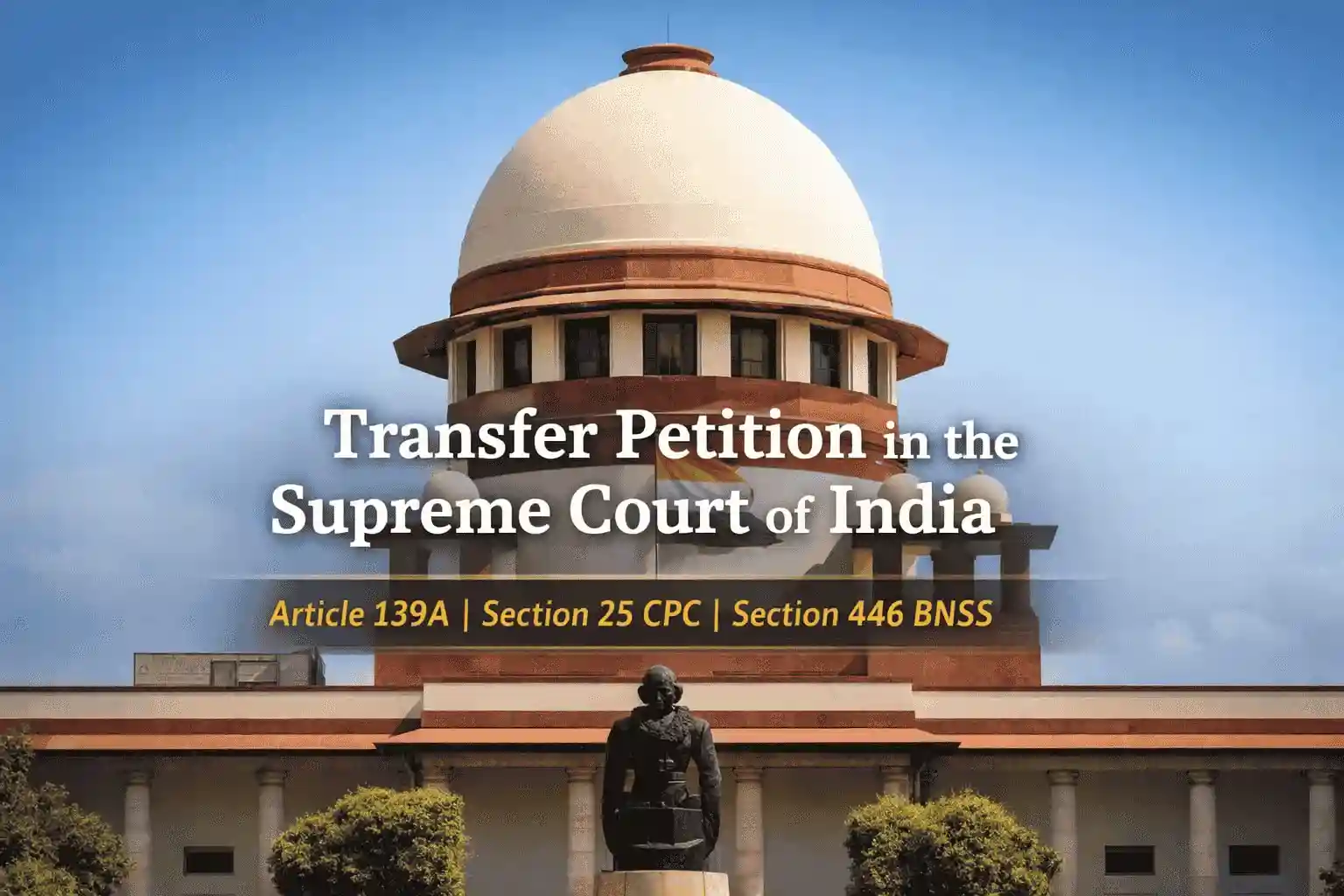
Supreme Court of India building – relevant to transfer petitions under Article 139A, Section 25 CPC, and Section 446 BNSS

A clear and structured guide to transfer petitions in the Supreme Court of India, explaining the jurisdiction under Article 139A, Section 25 CPC, and Section 446 BNSS. Includes key grounds, leading case laws, and practical insights from an Advocate-on-Record for assessing when inter-state transfer of a case is justified.

Cyber Fraud Crime: Complaints and Redressal in 2026

Standard Operating Procedure 2026 for cyber fraud complaints under NCRP and CFCFRMS – simple guide for citizens and banks. best cyber crime lawyer Delhi

This article provides a simple, step-by-step guide for citizens on how to report cyber-fraud crimes in 2026 using the NCRP and CFCFRMS systems. It explains how online financial fraud complaints are filed, how banks and law-enforcement respond, and what recovery and redressal processes are available. From lodging a complaint on the National Cybercrime Reporting Portal to understanding the new MHA SOP of 2026, this guide helps victims act quickly and correctly to maximise the chances of fund-freezing and recovery.

Section 3 – Definitions under the UP Apartment Act 2010 | Legal Commentary

best apartment law lawyer in Delhi Noida

This article provides a definitive clause-wise commentary on Section 3 of the UP Apartment Act 2010, explaining every statutory definition through practical illustrations and the Supreme Court’s ruling in Designarch. It clarifies the meaning of apartment, common areas, promoter obligations, and the Act’s mandatory character for group housing projects.

Curative Petition in the Supreme Court of India: Innovation, Jurisprudence, and Practice

Curative Petition in the Supreme Court of India under Order XLVIII – Law, Procedure and Landmark Cases including Rupa Ashok Hurra and DMRC

A Curative Petition is the Supreme Court’s rarest remedy to correct gross injustice after dismissal of a review petition. This guide explains its constitutional basis, Order XLVIII procedure, key cases like Rupa Ashok Hurra, DMRC and Navneet Kaur, and essential drafting strategy.

How to Draft a Special Leave Petition Under Article 136 That Survives the Admission Stage

pecial Leave Petition under Article 136 – Guide to Drafting an SLP that Survives the Supreme Court Admission Stage

A practical guide for Advocates-on-Record on drafting a Special Leave Petition under Article 136 that survives the Supreme Court’s admission stage. This article explains the constitutional foundation of SLP jurisdiction, how leave is granted, how to frame Questions of Law and Grounds with precision, and the drafting discipline required to avoid common causes of dismissal.

False Allegations of Sexual Offences and Judicial Scrutiny in India for Anticipatory Bail

Disgruntled Girl

Introduction The jurisprudence on anticipatory bail in India has undergone notable refinement as courts increasingly confront cases where allegations of rape or threats of prosecution for sexual offences appear to function as instruments of extortion, coercion or retaliation rather than as authentic assertions of victimisation. Although such misuse remains statistically limited, it raises serious doctrinal … Read more

Quashing of Income Tax Reassessment under Section 148 by High Court

This article provides a comprehensive guide to the law of reassessment under Sections 147–151 of the Income Tax Act, 1961, and explains how High Courts—especially the Delhi High Court—have been quashing Section 148 notices on grounds of limitation, invalid sanction, procedural lapses, and lack of jurisdiction. It offers a structured overview of the statutory framework, the reassessment procedure after the Finance Act 2021 & 2024, and landmark case law shaping today’s reassessment jurisprudence.

Special Leave Petition in Supreme Court: Law and Practice.

Lawyer arguing before judges for special leave to appeal under Article 136 — Supreme Court of India SLP concept.

This article explains why leave to appeal to the Supreme Court under Article 136 is considered extraordinary. It traces the history, discretionary nature, and judicial principles that make the Special Leave Petition a unique constitutional safeguard against injustice